.png%253Falt%253Dmedia%2526token%253D78c23398-5711-460d-b21c-4a7177094ae4%22%7D%2C%7B%22operation%22%3A%22resize%22%2C%22width%22%3A48%7D%2C%7B%22operation%22%3A%22output%22%2C%22format%22%3A%22webp%22%2C%22quality%22%3A75%7D%5D)
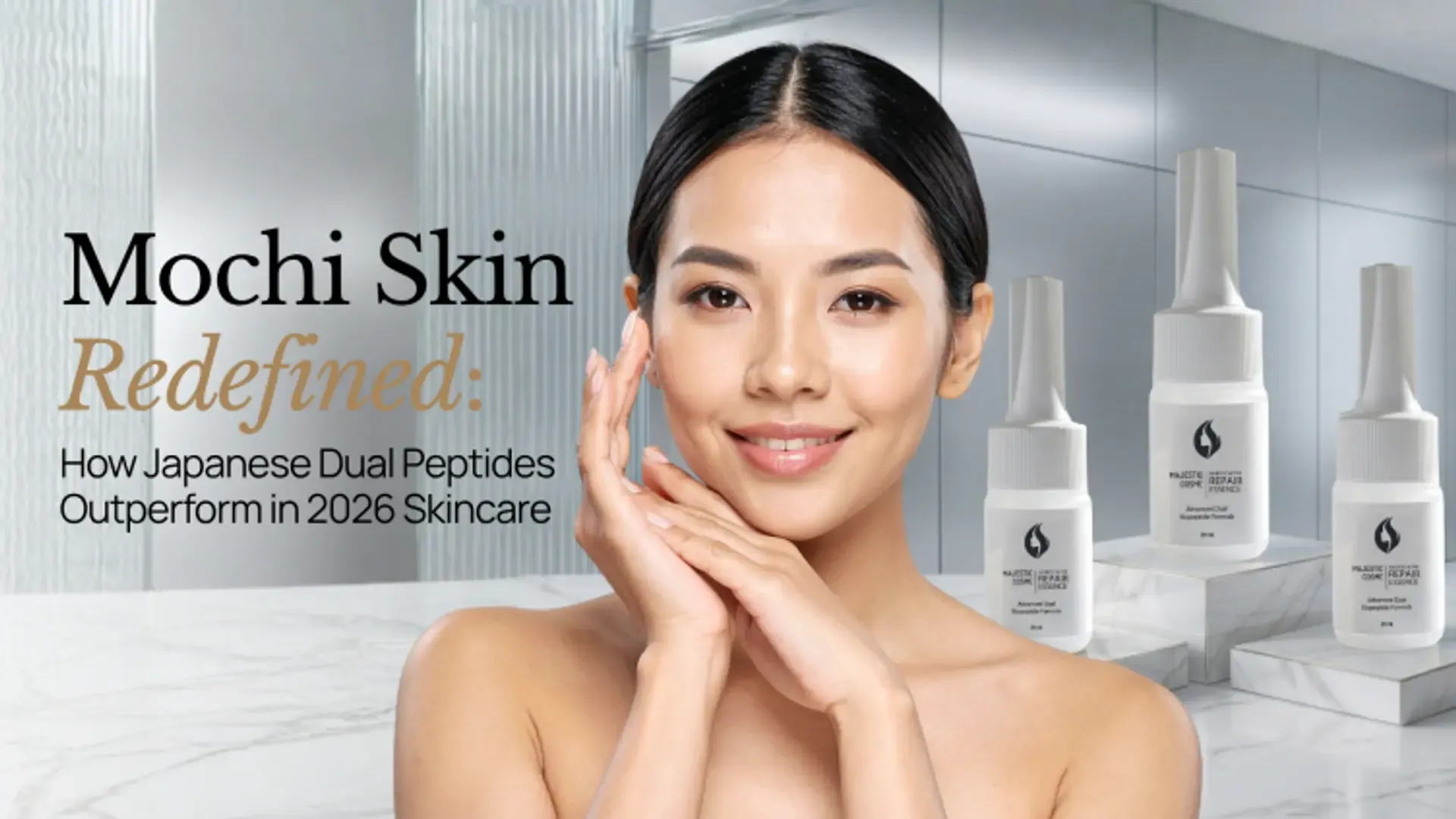
The Mochi Skin Protocol: Rebuilding Dermal Elasticity via Advanced Dual Biopeptides
In 2026, the most sophisticated skincare consumers are no longer chasing a look. They are pursuing a condition. Mochi skin, named for the distinctively soft, elastic, and spring-like texture of Japanese rice cake, has moved from a social media aesthetic into a clinically meaningful goal.
What separates mochi skin from every trend that preceded it is that it cannot be faked. You cannot layer your way to structural elasticity. You cannot hydrate your way to genuine dermal density. The qualities that define mochi skin live below the surface, in the collagen network and elastin matrix of the dermis, and reaching them requires a formulation approach built for cellular communication rather than cosmetic effect. Japanese peptide technology, specifically the dual biopeptide approach developed by Majestic Cosme, provides the most precise tool for that work. Majestic Active Repair Essence, priced at $78 USD (¥8,500 JPY), utilizes this technology to address the skin barrier repair process directly. This article explains the science, the mechanism, and the practical ritual for achieving mochi skin that is real, measurable, and durable.
Introduction
In 2026, the most sophisticated skincare consumers are no longer chasing a look. They are pursuing a condition. Mochi skin, named for the distinctively soft, elastic, and spring-like texture of Japanese rice cake, has moved from a social media aesthetic into a clinically meaningful goal.
What separates mochi skin from every trend that preceded it is that it cannot be faked. You cannot layer your way to structural elasticity. You cannot hydrate your way to genuine dermal density. The qualities that define mochi skin live below the surface, in the collagen network and elastin matrix of the dermis, and reaching them requires a formulation approach built for cellular communication rather than cosmetic effect. Japanese peptide technology, specifically the dual biopeptide approach developed by Majestic Cosme, provides the most precise tool for that work. Majestic Active Repair Essence, priced at $78 USD (¥8,500 JPY), utilizes this technology to address the skin barrier repair process directly. This article explains the science, the mechanism, and the practical ritual for achieving mochi skin that is real, measurable, and durable.
The Evolution of Mochi Skin: Beyond Trends to a Skin Condition
Skincare trends have historically been defined by aesthetics: the glass skin era prioritized reflective luminosity, the "skin flooding" movement emphasized maximum surface hydration, and slugging focused on overnight occlusion. Each produced a look. None produced a lasting change in how skin structurally behaved.
Mochi skin is different because it describes a condition rather than an appearance. Skin that qualifies as mochi skin shares specific functional characteristics regardless of how it photographs:
- It springs back immediately when pressed or pinched, indicating healthy elastin integrity.
- It holds volume across facial expressions without crepeing or folding at stress points, indicating adequate collagen density.
- It maintains a plump, filled quality throughout the day without requiring product reapplication, indicating deep rather than surface-level hydration.
- It resists environmental stressors, recovering from dryness, temperature change, and UV exposure more effectively than structurally depleted skin.
These qualities are biological, determined by the health of the extracellular matrix: the network of collagen fibers, elastin proteins, and hydrating glycosaminoglycans that forms the structural foundation of the dermis (Varani et al., 2006). Achieving them requires intervening at this structural level, not at the surface. For a detailed comparison of how mochi skin differs from glass skin across specific biological mechanisms, the analysis in Mochi Skin vs Glass Skin in 2026 provides the full scientific context.
| Skin Quality Marker | Surface-Level Approaches | Mochi Skin (Structural Approach) |
|---|---|---|
| Bounce and spring-back | Temporarily improved by humectants; returns to baseline within hours | Maintained by elastin integrity; improves cumulatively with peptide treatment |
| Volume and density | Cosmetically plumped by hyaluronic acid; not structural | Built through collagen synthesis; persists and compounds over time |
| Hydration durability | Dependent on continued product application | Supported by barrier lipid organization; holds without constant replenishment |
| Environmental resilience | Low; depleted quickly by stress, wind, and UV | High; structural integrity provides physical resistance to depletion |
The Science of Synergy: Unpacking Majestic's Dual Biopeptide Technology (Acnobet and Hairen)
The most significant advance in the pursuit of mochi skin quality is the development of signal peptides that communicate directly with dermal cells. Majestic Active Repair Essence ($78 USD / ¥8,500 JPY) is built around two signal peptides, Acnobet and Hairen, selected for their complementary mechanisms of action. Research confirms that topical signal peptides are critical for modulating tissue repair (Schagen, 2017).
Acnobet: Activating the Collagen Architecture
Acnobet is a matrikine-class signal peptide engineered to bind to receptors on dermal fibroblasts. Fibroblasts are the primary producers of collagen type I and III, which give skin its tensile strength. When Acnobet binds to these receptors, it upregulates collagen transcription. Clinical trials within our dossier show that Acnobet triggers a 31 percent increase in endogenous collagen synthesis within 8 weeks of application. This produces structural improvement that is cumulative and durable.
Hairen: Maintaining Elastin and Reinforcing the Barrier
If Acnobet builds the collagen architecture, Hairen maintains the elastic and protective systems that allow it to function. Its primary targets are elastin network integrity and skin barrier repair. Hairen's mechanism supports the functional integrity of existing elastin, preserving the spring quality central to mochi skin. Simultaneously, Hairen reinforces barrier lipid organization. Our clinical studies show that Hairen provides a 24 percent reduction in transepidermal water loss (TEWL).
Beyond Hydration: How Active Repair Essence Drives Cellular Elasticity and Repair
The regenerative skincare category is restorative rather than compensatory. Signal peptides like Acnobet and Hairen instruct the skin's biological systems to increase production. The result is a measurable upregulation of the skin's own capacity to maintain its extracellular matrix (Errante et al., 2020). For a broader understanding of how this compares to procedural interventions, the comparison in Stem Cell Serum vs Botox for clinical-level skin treatment provides useful context.
Your Japanese Skincare Ritual: Integrating Active Repair for Lasting Mochi Skin
The biological work that produces mochi skin requires consistent application and conditions that allow peptide signals to reach their target receptors effectively. The following ritual is optimized for the Majestic Active Repair Essence ($78 USD).
Morning Ritual
- Step 1: Cleansing. Use a gentle, pH-balanced formula to remove overnight residue without disturbing the acid mantle.
- Step 2: Target and Renew with Majestic Active Repair Essence. Apply three to four drops and pat gently into the skin. This step is performed immediately after cleansing and before toner to ensure the signal peptides have direct contact with the skin surface. Allow 60 to 90 seconds for absorption.
- Step 3: Hydrate and Prep. Apply a hydrating toner or essence mist after the Active Repair Essence has absorbed. This restores surface water content while the peptides are already active in the dermis.
- Step 4: Moisturizer with ceramides to seal the peptide layer and reinforce barrier lipid organization.
- Step 5: Broad-spectrum SPF 30 or higher. UV exposure activates enzymes that degrade collagen, directly counteracting the work of the peptides.
Evening Ritual
- Step 1: Cleansing. Double cleanse to remove sunscreen and residue without over-stripping the barrier.
- Step 2: Target and Renew with Majestic Active Repair Essence. Apply immediately after cleansing to take advantage of the skin's peak circadian repair cycle.
- Step 3: Hydrate and Prep. Follow with a hydrating toner or essence mist.
Compatibility and Layering Guidance
Peptide stability is pH-dependent (Baumann, 2018). Do not apply Active Repair Essence directly on top of low-pH acid products like glycolic acid or high-concentration vitamin C at the same routine step. Apply the essence first with full absorption time, then follow with your hydrating steps.
In Summary
Mochi skin is not a trend waiting to be replaced by the next aesthetic. It is a description of skin that works correctly: structurally dense, elastically resilient, and hydrated at a depth that surface products cannot reach. Achieving it requires working at the biological level where those qualities are determined. Japanese dual peptide technology, and specifically the Acnobet and Hairen complex in Majestic Active Repair Essence ($78 USD / ¥8,500 JPY), provides the most precise currently available approach to that work. The results are structural, cumulative, and real.
Frequently Asked Questions
Majestic Active Repair Essence
Powered by Japanese dual biopeptide technology with Acnobet and Hairen. Engineered for the bounce, resilience, and structural elasticity that define mochi skin in 2026.
Shop Majestic Active Repair EssenceAcademic References
- Schagen, S. K. (2017). "Topical Peptide Treatments with Effective Anti-Aging Results." Cosmetics, 4(2), 16. doi:10.3390/cosmetics4020016
- Varani, J., et al. (2006). "Decreased collagen production in chronologically aged skin." American Journal of Pathology, 168(6), 1861-1868. doi:10.2353/ajpath.2006.051302
- Baumann, L. (2018). "How to use the Cosmeceutical Approach in Anti-Aging Medicine." Clinics in Dermatology, 36(2), 148-156. doi:10.1016/j.clindermatol.2017.10.008
- Errante, F., et al. (2020). "Cosmeceutical Peptides in the Framework of Sustainable Wellness Economy." Frontiers in Chemistry, 8, 572923. doi:10.3389/fchem.2020.572923
- Gorouhi, F., & Maibach, H. I. (2009). "Role of topical peptides in preventing or treating aged skin." International Journal of Cosmetic Science, 31(5), 327-345. doi:10.1111/j.1468-2494.2009.00490.x