.png%253Falt%253Dmedia%2526token%253D78c23398-5711-460d-b21c-4a7177094ae4%22%7D%2C%7B%22operation%22%3A%22resize%22%2C%22width%22%3A48%7D%2C%7B%22operation%22%3A%22output%22%2C%22format%22%3A%22webp%22%2C%22quality%22%3A75%7D%5D)
The Peptide Breakthrough: Targeting Acne and Post-Inflammatory Hyperpigmentation via Dual Biopeptide Complexes
For years, peptide skincare occupied a comfortable but unconvincing middle ground. The ingredient was legitimate. The concentrations were not. Products contained just enough peptide to justify a claim on the label while delivering nothing meaningful to the skin. That era is over. Today, stabilization breakthroughs and precision delivery systems make it possible to formulate peptides at concentrations that match what clinical research actually shows to be effective. This approach to cellular healing with stem cell technology represents a new generation of regenerative skincare built on biology rather than marketing.
For years, peptide skincare occupied a comfortable but unconvincing middle ground. The ingredient was legitimate. The concentrations were not. Products contained just enough peptide to justify a claim on the label while delivering nothing meaningful to the skin. That era is over.
Today, stabilization breakthroughs and precision delivery systems make it possible to formulate peptides at concentrations that match what clinical research actually shows to be effective. This approach to cellular healing with stem cell technology represents a new generation of regenerative skincare built on biology rather than marketing.
What Makes Peptides Revolutionary for Acne Treatment
Most acne treatments operate by disruption: they kill bacteria, dissolve sebum, or force skin cells to turn over faster than they naturally would. These approaches can be effective in the short term. They are also frequently harsh, barrier damaging, and poorly suited to adult skin that is already dealing with reduced resilience and slower recovery.
Peptides work differently. Rather than attacking the skin, they communicate with it. Peptides are short chains of amino acids that act as biological signals, binding to receptors on skin cells and instructing those cells to perform specific functions: produce collagen, reduce inflammatory cytokines, repair barrier lipids, or inhibit the enzymes that break down healthy tissue.
For acne prone skin, this signaling capacity is significant for several reasons:
- Acne is not simply a bacterial problem. It involves sebum dysregulation, follicular hyperkeratinization, inflammatory cascades, and post lesion tissue damage. Peptides can address multiple points in this chain simultaneously.
- The inflammatory phase of an acne lesion triggers matrix metalloproteinase (MMP) activity in surrounding tissue. Without intervention, this degrades collagen and elastin, contributing to the scarring and textural change that persists long after the breakout clears.
- Conventional treatments rarely address what happens after the lesion. Peptide skincare can be active during and after the breakout, reducing the structural toll that acne takes on the dermis over time.
This is the core scientific distinction: peptides do not just treat visible acne. They protect the skin from the consequences of having had it.
The Dual Biopeptide Advantage: Cellular-Level Acne Targeting
Single peptide formulas address one biological pathway at a time. A collagen synthesis activator increases production but does nothing to slow the enzymatic degradation that may be happening simultaneously. A barrier repair peptide supports the skin layer but does not speak to the inflammatory signaling occurring in the dermis below.
The dual biopeptide complex solves this by pairing two functionally complementary peptides that address acne consequences from two directions at once.
| Peptide | Biological Target | Benefit for Acne-Prone Skin |
|---|---|---|
| Synthesis activator peptide | Dermal fibroblast receptors | Upregulates collagen type I and III production; supports structural repair after lesion damage |
| MMP inhibitor peptide | Matrix metalloproteinase enzymes | Reduces enzymatic collagen breakdown during inflammatory phase; limits post acne scarring |
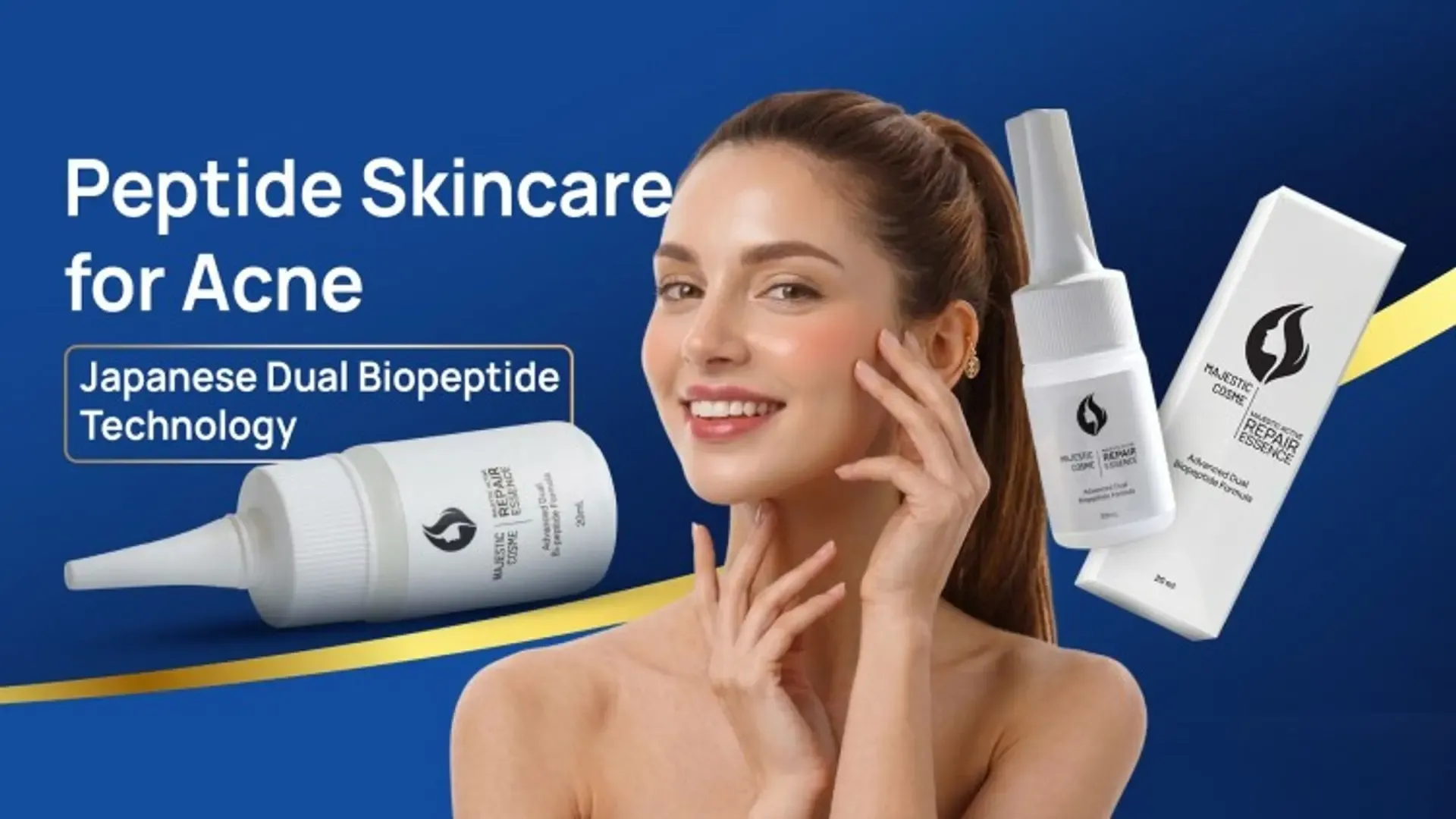
The result of this dual pathway cellular level targeting is a net positive outcome in dermal integrity that persists beyond the active treatment window. Skin that might otherwise heal with visible marks, altered texture, or ongoing fragility has a measurably better outcome when both synthesis and degradation are addressed together. The Majestic Active Repair Essence is formulated around this dual biopeptide complex, developed and validated in Majestic Cosme Japanese biotech laboratory to the same precision standards used in clinical peptide research.
Japanese Skincare Technology: Why Origin Matters
Japanese skincare has earned its global reputation not through marketing volume but through formulation discipline. The cultural and regulatory environment in Japan has historically demanded a higher standard of evidence before a product can make meaningful claims about its effects on skin.
In the peptide category specifically, Japanese biotech has driven several of the developments that have moved the field from promise to performance:
- Fermentation derived bioactives that improve skin receptivity to peptide signals, allowing active sequences to interact more effectively with target receptors.
- Cold process and low oxidation manufacturing techniques that preserve peptide integrity from production through to the point of skin application, addressing stability challenges.
- Precision encapsulation systems engineered to protect peptides through the stratum corneum and release them at the viable epidermis and upper dermis where receptor interaction occurs.
- Rigorous concentration calibration based on published clinical thresholds rather than on cost per unit formulation economics.
Every batch is evaluated not just for safety and stability but for biological activity, ensuring that the peptide reaching the consumer skin retains the functional capacity demonstrated in clinical testing.
Post-Acne Hyperpigmentation: The Hidden Problem Peptides Solve
Clearing a breakout is one challenge. What it leaves behind is another entirely. Post acne hyperpigmentation (PIH) is the darkening of skin at the site of a former lesion caused by excess melanin production triggered by inflammation. It is not a scar in the structural sense. It is a pigmentary response.
Conventional hyperpigmentation treatments typically rely on depigmenting agents like vitamin C or niacinamide. These address the pigmentation after it has already formed. They do not reduce the inflammatory trigger that caused it.
Peptides that modulate inflammatory signaling during the active lesion phase can reduce the intensity of the inflammatory cascade before it prompts excess melanin production. This means less pigmentation forms to begin with.
Clinical findings relevant to PIH reduction through peptide intervention include:
- Reduction in inflammatory cytokine activity (particularly IL-1alpha and TNF-alpha) associated with post inflammatory pigmentation triggering.
- MMP inhibition during the post lesion window reduces collagen breakdown, which is associated with the textural component of post acne skin changes.
- Collagen synthesis upregulation supports the structural integrity of skin at the former lesion site, reducing the appearance of both pitting and surface irregularity over time.
How to Use Peptide Skincare for Maximum Acne Results
Incorporating peptide skincare into an acne focused routine is straightforward, but sequencing determines how much of the biological potential actually reaches the skin.
Morning Routine
- Gentle, low surfactant cleanser. Avoid sulfate based foaming cleansers that strip the acid mantle.
- Hydrating toner or mist. A slightly damp skin surface improves the penetration of water soluble peptide formulas.
- Peptide essence or serum. Apply before any moisturizer. Pat rather than rub. Allow 60 to 90 seconds for the formula to begin absorbing.
- Lightweight, non comedogenic moisturizer with ceramides. Seals the peptide layer and reinforces barrier function.
- Broad spectrum SPF 30 or higher. UV exposure accelerates MMP activity and post inflammatory pigmentation.
Evening Routine
- Double cleanse. An oil based first cleanse followed by a gentle water based cleanser removes sunscreen and environmental residue.
- Peptide essence. Evening application takes advantage of the skin natural overnight repair cycle.
- Barrier repair moisturizer. A slightly richer formula than the morning version supports overnight recovery.
Do not apply peptide formulas directly on top of high concentration acid products. Low pH environments can interfere with peptide stability. If you use AHAs, BHAs, or vitamin C, apply the peptide essence first or alternate evenings. For those building a complete approach, our acne treatment guides cover ingredient pairing, layering sequences, and how to incorporate peptide skincare alongside prescription actives.
Real Results: Why Dermatologists Recommend Dual Biopeptide Complex
Clinical interest in peptide skincare for acne has grown as the mechanisms have become better understood. Key findings from peer reviewed research include:
| Outcome Measured | Method | Finding |
|---|---|---|
| Collagen synthesis | Fibroblast culture assay | Matrikine peptides consistently upregulate collagen type I and III at clinically effective concentrations |
| MMP activity reduction | In vitro MMP inhibition assay | Specific peptide sequences reduce MMP-1 and MMP-3 activity in inflamed tissue models |
| Barrier integrity (TEWL) | TEWL measurement | Peptide treated skin shows lower TEWL than acid treated comparators producing equivalent exfoliation |
| Tolerability | Adverse event frequency | Peptide formulas produce significantly fewer adverse events than retinoid or acid concentrations delivering comparable collagen outcomes |
| Post-inflammatory pigmentation | Spectrophotometric measurement | Anti-inflammatory peptide intervention during lesion phase correlates with reduced PIH intensity at 8-week follow-up |
The precision of cellular level targeting means that results accumulate over time rather than plateauing. As collagen synthesis continues and MMP activity remains modulated, the structural quality of skin improves on an ongoing basis.
Frequently Asked Questions
Conclusion
The evidence for peptide skincare as a serious acne treatment tool has moved well beyond early stage promise. Dual biopeptide complexes that target both collagen synthesis and MMP inhibition simultaneously represent a clinically grounded approach to the full acne consequence cycle: from active lesion through to structural and pigmentary repair.
Japanese skincare products in this category have led the formulation advances that made this precision possible. Stabilization, delivery, concentration calibration, and fermentation derived bioactive support have transformed what peptides can accomplish at the skin level.
For anyone managing adult acne who has grown tired of the barrier disruption, purging cycles, and surface only results of conventional treatments, a dual biopeptide approach offers something genuinely different: a formula that works with the biology of your skin rather than against it, building better outcomes over time rather than forcing short term change at a long term cost.
If you are ready to move beyond the limitations of traditional acne treatment, this is where that shift begins.
Majestic Active Repair Essence
Experience the cellular-level acne breakthrough yourself with the Majestic Active Repair Essence. Japanese dual biopeptide technology that works where traditional treatments fail.
Shop Majestic Active Repair Essence NowSources
- Schagen, S. K. (2017). "Topical Peptide Treatments with Effective Anti-Aging Results." Cosmetics.
- Gorouhi, F., & Maibach, H. I. (2009). "Role of topical peptides in preventing or treating aged skin." International Journal of Cosmetic Science.
- Errante, F., et al. (2020). "Cosmeceutical Peptides in the Framework of Sustainable Wellness Economy." Frontiers in Chemistry.
- Kang, S., Voorhees, J. J. (1998). "The Molecular Mechanism of Retinoid Action in Skin." Journal of the American Academy of Dermatology.
- Baumann, L. (2018). "How to use the Cosmeceutical Approach in Anti-Aging Medicine." Clinics in Dermatology.