.png%253Falt%253Dmedia%2526token%253D78c23398-5711-460d-b21c-4a7177094ae4%22%7D%2C%7B%22operation%22%3A%22resize%22%2C%22width%22%3A48%7D%2C%7B%22operation%22%3A%22output%22%2C%22format%22%3A%22webp%22%2C%22quality%22%3A75%7D%5D)
Photocellular Resilience: Activating Heat Shock Proteins and Upstream DNA Repair Architecture
For most of the past century, sun protection meant one thing: blocking UV rays before they reached the skin. Apply your SPF, go about your day, reapply when needed. The logic was straightforward, and for preventing sunburn, it worked. But for preventing the deeper cellular damage that drives visible aging, it has never been enough.
A new category of formulation has emerged from Japanese biotech research that reframes what a morning sun protection product should actually do. DNA repair day cream does not just intercept UV radiation. It actively works to correct the cellular damage that UV causes at the DNA level, using biological mechanisms that regular SPF products have never attempted to engage.
The distinction matters more after 30, when the skin own repair capacity begins a measurable decline. Understanding what separates active sun protection from passive UV filtering is what this article is designed to clarify.
Introduction
For most of the past century, sun protection meant one thing: blocking UV rays before they reached the skin. Apply your SPF, go about your day, reapply when needed. The logic was straightforward, and for preventing sunburn, it worked. But for preventing the deeper cellular damage that drives visible aging, it has never been enough.
A new category of formulation has emerged from Japanese biotech research that reframes what a morning sun protection product should actually do. DNA repair day cream does not just intercept UV radiation. It actively works to correct the cellular damage that UV causes at the DNA level, using biological mechanisms that regular SPF products have never attempted to engage.
The distinction matters more after 30, when the skin own repair capacity begins a measurable decline. Understanding what separates active sun protection from passive UV filtering is what this article is designed to clarify.
The Evolution from Passive to Active Sun Protection
Traditional sunscreen operates entirely upstream. It places a filter between the skin and incoming UV radiation, either absorbing UV energy and converting it to heat (chemical filters) or physically reflecting it (mineral filters). The limitation of this model has three parts: no sunscreen provides complete interception, real world application doses are often insufficient, and passive blocking does nothing about damage already present.
Active sun protection addresses a different question: what happens after UV damage occurs, and how can a topical product support the skin ability to respond to it? This is the territory where DNA repair day cream operates. This shift parallels a broader evolution in regenerative skincare thinking. Those familiar with how stem cell skincare compares to traditional anti aging approaches will recognize the same underlying principle: the most meaningful advances come from working with the skin own biological systems.
How Heat Shock Proteins Transform Sun Care
Heat Shock Protein skincare represents one of the most significant developments in active sun protection over the past decade. Heat Shock Proteins, or HSPs, are proteins that cells produce in response to stress. When a skin cell is damaged by UV exposure, HSPs function as molecular chaperones: they stabilize other proteins damaged by stress, prevent cellular dysfunction from cascading, and support structural integrity during recovery.
HSP70 and HSP27 are the two most studied in the context of UV damage. Research has shown that their upregulation following UV exposure is directly associated with reduced cell death and better preservation of collagen producing fibroblasts. DNA repair day cream formulations involve bioactive compounds that either directly modulate HSP expression or reduce the cellular stress burden that HSP systems work against.
Why Traditional SPF Is Not Enough After 30
Research in photobiology has established that nucleotide excision repair, the primary mechanism by which skin cells correct UV induced DNA lesions, becomes measurably less efficient with age. This declining repair efficiency means unrepaired photolesions accumulate faster, melanin stress signals remain active longer, and collagen degradation compounds over time.
Regular SPF addresses none of this. It reduces the rate of new damage but the backlog continues to grow. A DNA repair day cream is designed specifically for this gap. By supporting the skin repair pathways through topically delivered bioactive compounds, it compensates for the age related decline in natural repair efficiency.
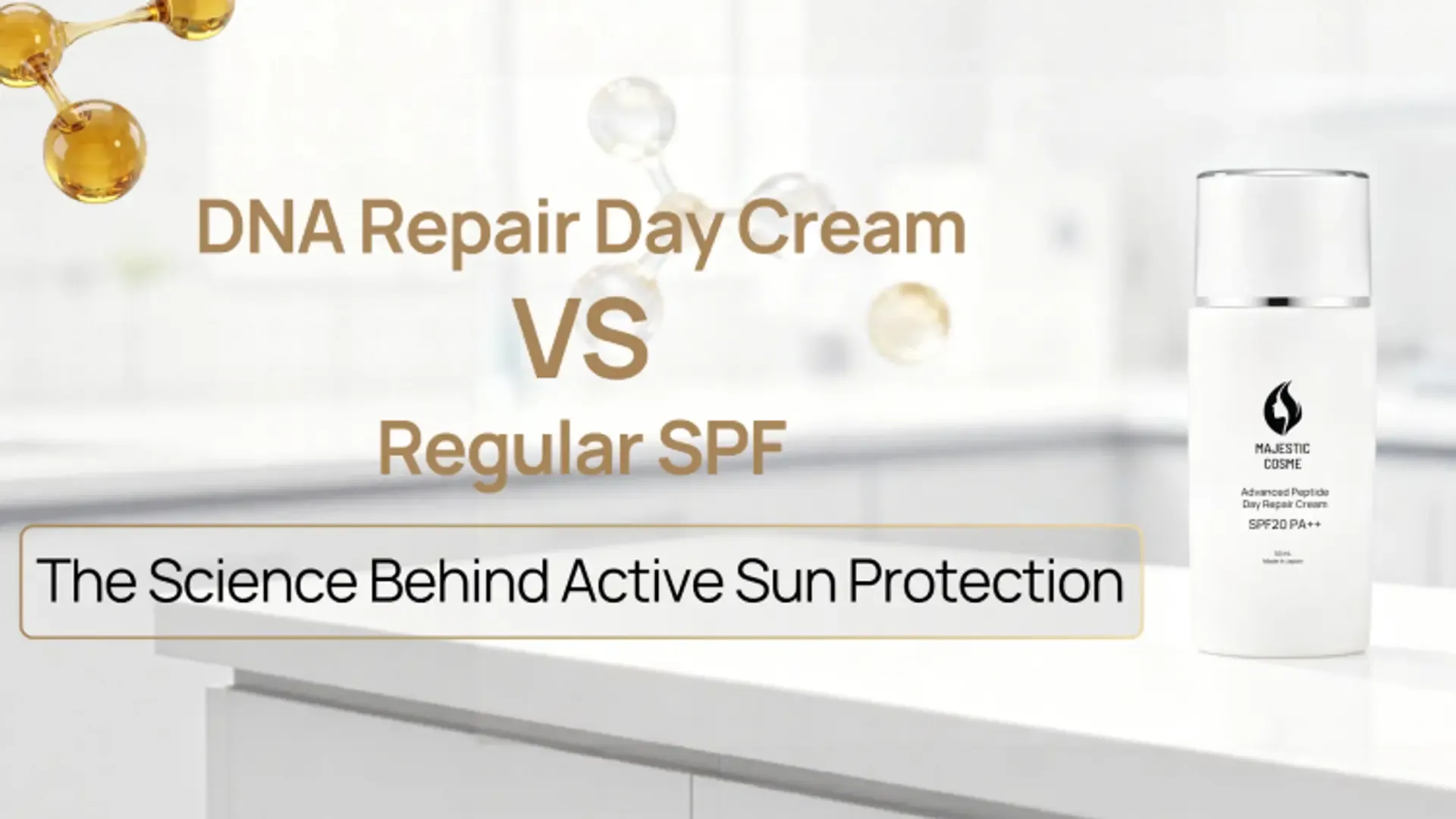
| What It Provides | Regular SPF | DNA Repair Day Cream |
|---|---|---|
| UV ray blocking | Yes | Yes (mineral UV filters) |
| Photostable coverage | Variable | Yes (mineral filters stable) |
| Cellular DNA repair support | No | Yes (enzyme complex) |
| HSP activation support | No | Yes |
| Melanin signal interruption | No | Yes (ASP technology) |
| Collagen signaling | No | Yes (peptide complex) |
| Makeup primer function | Rarely | Yes |
The 3-in-1 Advantage: Protection, Repair, and Prevention
A genuine DNA repair day cream features three core functions that operate through clinically grounded mechanisms:
- Protection is delivered through Japanese Mineral UV Cut technology using micronized zinc oxide and titanium dioxide for photostable broad spectrum coverage that does not degrade throughout the day.
- Repair is supported through a bioactive complex that works alongside the skin nucleotide excision repair pathway to process existing photolesions.
- Prevention operates through ASP (Aspartyl Stearate) technology, which interrupts the melanin signaling cascade before new pigment production is initiated.
For those evaluating how this fits into a complete protocol, Majestic Day Repair formulation details and ingredient philosophy are available on the product page.
Clinical Evidence: DNA Repair vs Conventional Sunscreen
The case for DNA repair day cream rests on peer reviewed research. A foundational study in the Journal of Investigative Dermatology demonstrated that topical application of photolyase produced measurably lower cyclobutane pyrimidine dimer (CPD) counts in human skin following UV exposure compared to sunscreen alone.
Subsequent research published in Photochemical and Photobiological Sciences has confirmed that UV induced DNA lesions are the primary upstream trigger for hyperpigmentation and accelerated photoaging. Furthermore, a 2013 analysis in Clinical, Cosmetic and Investigational Dermatology estimated that UV radiation accounts for approximately 80 percent of visible facial aging.
For more on biotech driven skincare, the Majestic Day Repair journal covers the science behind the full product line in depth.
Application Guide: Getting the Most from Active Sun Protection
- Apply as the final skincare step each morning after water based serums have fully absorbed.
- Use a pea sized amount spread evenly across the face, jaw, and neck using upward strokes.
- Wait 60 seconds before applying makeup to allow the mineral UV layer to settle and the primer surface to form.
- Consistency over 8 to 12 weeks produces measurable improvements in tone and texture as the accumulated photolesion burden decreases.
Frequently Asked Questions
Conclusion
The gap between regular SPF and DNA repair day cream is a difference in what the product is designed to do. Regular SPF was built to block; DNA repair day cream was built to protect and repair. For women over 30 managing decades of UV accumulation, active sun protection built around Heat Shock Protein support and DNA repair enzyme activity represents a more complete response to what UV radiation actually does to skin over a lifetime.
Majestic Day Repair
Experience the pinnacle of Japanese active sun protection. Our specialized DNA repair formula has seen unprecedented demand and is currently out of stock as we maintain our rigorous pharmaceutical-grade production standards.
We expect the next limited batch to be ready by the end of April 2026. Secure your place at the front of the line to ensure you don't miss this restorative morning ritual.
Scientific Sources
- Stege, H., et al. (2000). "Enzyme plus sunscreen versus either sunscreen or enzyme alone for the UV-induced DNA damage in skin." Journal of Investigative Dermatology.
- Schuch, A. P., et al. (2017). "DNA damage as a biological sensor of UV exposure." Photochemical and Photobiological Sciences.
- Trautinger, F. (2001). "Heat shock proteins in the photobiology of human skin." Journal of Photochemistry and Photobiology B: Biology.
- Flament, F., et al. (2013). "Effect of the sun on visible clinical signs of aging in Caucasian skin." Clinical, Cosmetic and Investigational Dermatology.
- Budden, T., and Bowden, N. A. (2013). "The role of altered nucleotide excision repair and UVB-induced DNA damage in melanoma development." International Journal of Molecular Sciences.