.png%253Falt%253Dmedia%2526token%253D78c23398-5711-460d-b21c-4a7177094ae4%22%7D%2C%7B%22operation%22%3A%22resize%22%2C%22width%22%3A48%7D%2C%7B%22operation%22%3A%22output%22%2C%22format%22%3A%22webp%22%2C%22quality%22%3A75%7D%5D)
.jpg%253Falt%253Dmedia%2526token%253D789f44f6-3320-4e66-8031-3c0803834f89%22%7D%2C%7B%22operation%22%3A%22resize%22%2C%22width%22%3A1920%7D%2C%7B%22operation%22%3A%22output%22%2C%22format%22%3A%22webp%22%2C%22quality%22%3A75%7D%5D)
Photocellular Restoration: DNA Repair Mechanisms and Mineral UV Cut Engineering
Table of Contents
- Introduction
- The Problem With Traditional Sunscreen
- What Makes DNA Repair Skincare Revolutionary
- Why UV Protection Alone Isn't Enough
- The Science Behind DNA Repair Technology
- Mineral vs. Chemical Sunscreen
- How ASP Stops a Dark Spot Before It Forms
- The Fourth Layer: Biopeptide Collagen Signaling
- Daily Application Guide
- Beyond Sunscreen: Preventative Age Spots Treatment
- Choosing the Best Sunscreen with DNA Repair
- Frequently Asked Questions
- Scientific Sources
For decades, the promise of sun protection meant a single action: block. Apply sunscreen, shield your skin from UV rays, and call it a day. But skin scientists now understand something far more important. UV radiation leaves behind molecular damage that no sunscreen, no matter how high the SPF, can undo after the fact. DNA repair skincare changes the equation entirely by addressing both prevention and regeneration in a single anti aging day cream.
If you are serious about long term skin health, exploring a regenerative skincare approach is no longer optional. It is where the science is pointing, and where the most meaningful results are being seen.
For decades, the promise of sun protection meant a single action: block. Apply sunscreen, shield your skin from UV rays, and call it a day. But skin scientists now understand something far more important. UV radiation leaves behind molecular damage that no sunscreen, no matter how high the SPF, can undo after the fact. DNA repair skincare changes the equation entirely by addressing both prevention and regeneration in a single anti aging day cream.
If you are serious about long term skin health, exploring a regenerative skincare approach is no longer optional. It is where the science is pointing, and where the most meaningful results are being seen.
The Problem With Traditional Sunscreen (Most Only Block, Never Repair)
Standard sunscreens work by absorbing or reflecting UV radiation before it penetrates the skin. This is genuinely useful. Consistent use reduces sunburn risk, lowers the likelihood of UV induced mutations, and delays visible signs of aging. So far, so good.
The limitation, however, is fundamental: sunscreen is passive. It acts only in the moment of application. It does nothing for yesterday's damage, last summer's cumulative exposure, or the low grade UV stress your skin absorbs through a car window on a cloudy Tuesday.
Skin cells experience UV induced DNA lesions called cyclobutane pyrimidine dimers (CPDs) and 6 4 photoproducts with every significant sun exposure. These lesions distort the DNA double helix. If unrepaired, they can trigger premature cellular aging, pigmentation irregularities, and over time, more serious cellular dysfunction.
"A sunscreen that only blocks is like a helmet worn after a fall. Protection for next time, but no help for the injury already sustained."
No standard SPF product corrects these lesions. They accumulate silently beneath a protected surface, contributing to the fine lines, uneven tone, and loss of radiance that we often attribute simply to getting older.
What Makes DNA Repair Skincare Revolutionary
DNA repair skincare moves the conversation from passive protection to active correction. Rather than simply deflecting UV rays, these formulations deliver biological tools that help the skin fix cellular damage at the source.
The foundation of this technology is enzyme based. Specific enzymes, most notably photolyases derived from extremophile organisms such as Anacystis nidulans (a cyanobacterium that thrives under intense UV radiation), are able to recognize and reverse CPD type DNA lesions. When activated by visible light, these enzymes bind to damaged DNA sites and catalyze repair through a process called photoreactivation.
Alongside enzyme delivery, the most advanced formulations incorporate Heat Shock Protein (HSP) activation. HSPs are molecular chaperones, proteins the body produces naturally in response to cellular stress, that help stabilize damaged proteins and support the repair machinery already within your cells.
- Photolyase enzymes identify and reverse cyclobutane pyrimidine dimers in UV-damaged DNA
- Heat Shock Proteins stabilize stressed cellular structures and activate endogenous repair pathways
- Antioxidant co-factors reduce oxidative stress that compounds DNA damage
- Barrier-supporting actives keep the protective lipid layer intact during cellular repair
Clinical studies on topically applied photolyase have shown statistically significant reductions in CPD counts following UV exposure when the enzyme is included in a sunscreen or day cream formulation. This represents a genuinely new category of skin protection, one that does not just defend but actively restores.
Why UV Protection Alone Isn't Enough Anymore
There is a reason dermatologists increasingly speak of photoaging as a cumulative phenomenon. Each UV encounter layers damage onto the last. By the time fine lines become visible, the skin own DNA repair capacity, which naturally declines from our mid twenties onward, has already been overwhelmed many times over.
Purely passive UV protection skincare addresses only one dimension of this problem. It slows the rate of incoming damage but cannot compensate for the deficit that has built up over years. This gap is precisely where active repair technology becomes valuable.
Consider also that UV radiation is not the only source of oxidative and cellular stress. Infrared radiation, visible light (particularly high energy violet light), pollution, and even psychological stress can generate reactive oxygen species that compound DNA damage. A comprehensive approach to photoaging requires both blocking and correcting.
Mineral UV filters, specifically zinc oxide and titanium dioxide, offer one part of this answer. They provide broad spectrum, photostable protection without the concerns associated with some chemical UV absorbers. But even the best mineral UV filters leave the accumulated damage of previous exposures entirely unaddressed.
The Science Behind DNA Repair Skincare Technology
Understanding how this technology functions makes it easier to evaluate products and set realistic expectations. The process works in two complementary stages.
Stage One: Enzymatic Repair
Photolyase enzymes, when formulated into liposomal carriers that allow skin penetration, locate UV induced DNA lesions in the epidermis. On exposure to visible light (which is always present in daylight conditions), these enzymes absorb photons and use the energy to break the abnormal chemical bond linking the damaged pyrimidine bases. The DNA strand is restored to its original configuration without any intermediary cuts or strand breaks.
Stage Two: Heat Shock Protein Activation
Heat Shock Proteins, particularly HSP70 and HSP47, are produced by skin cells when they experience thermal or UV stress. Topical formulations designed to upregulate HSP expression, through ingredients such as heat treated Thermus thermophilus ferment extract, amplify this protective response. HSPs act as chaperones, guiding damaged proteins toward either correct refolding or safe degradation, and they support the DNA repair enzymes in functioning efficiently.
Together, these mechanisms represent what researchers call an inside-out model of skin protection. The skin is not just shielded from the outside but equipped with enhanced repair capability from within. This is the scientific basis of DNA repair skincare at its most sophisticated level. For those interested in how regenerative biology is reshaping cosmetic science more broadly, advanced stem cell technology offers similar regenerative benefits by supporting the skin own renewal architecture rather than overriding it.
Mineral vs. Chemical Sunscreen: Why the Filter Choice Matters
Not all UV filters are built the same, and the difference matters for daily long-term use, not just single-day protection. Chemical filters such as avobenzone, oxybenzone, and octinoxate work by absorbing UV radiation and converting it into heat. They are effective, but they come with two documented trade-offs: avobenzone specifically undergoes photodegradation, losing meaningful UVA-filtering efficacy within hours of application, and multiple peer-reviewed studies have detected common chemical UV actives in blood, urine, and breast milk following topical use.
Mineral filters, zinc oxide and titanium dioxide, work differently. They sit on the skin surface and physically reflect UV radiation rather than absorbing it. They do not degrade under sun exposure and are not absorbed systemically, which is why Majestic Day Repair Cream is built on a mineral base rather than a chemical one. Japanese micronization and surface-coating techniques solve the classic objection to mineral sunscreen, the white cast and heavy texture, producing a finish that is invisible, lightweight, and compatible with makeup.
Inside the Signal: How ASP Stops a Dark Spot Before It Forms
When UV radiation damages a skin cell, that cell releases alpha-MSH (alpha-melanocyte stimulating hormone), a distress signal that travels to nearby melanocytes and instructs them to produce melanin. Repeated daily UV exposure means this command is issued again and again in the same areas of skin, and the cumulative result is a visible dark spot.
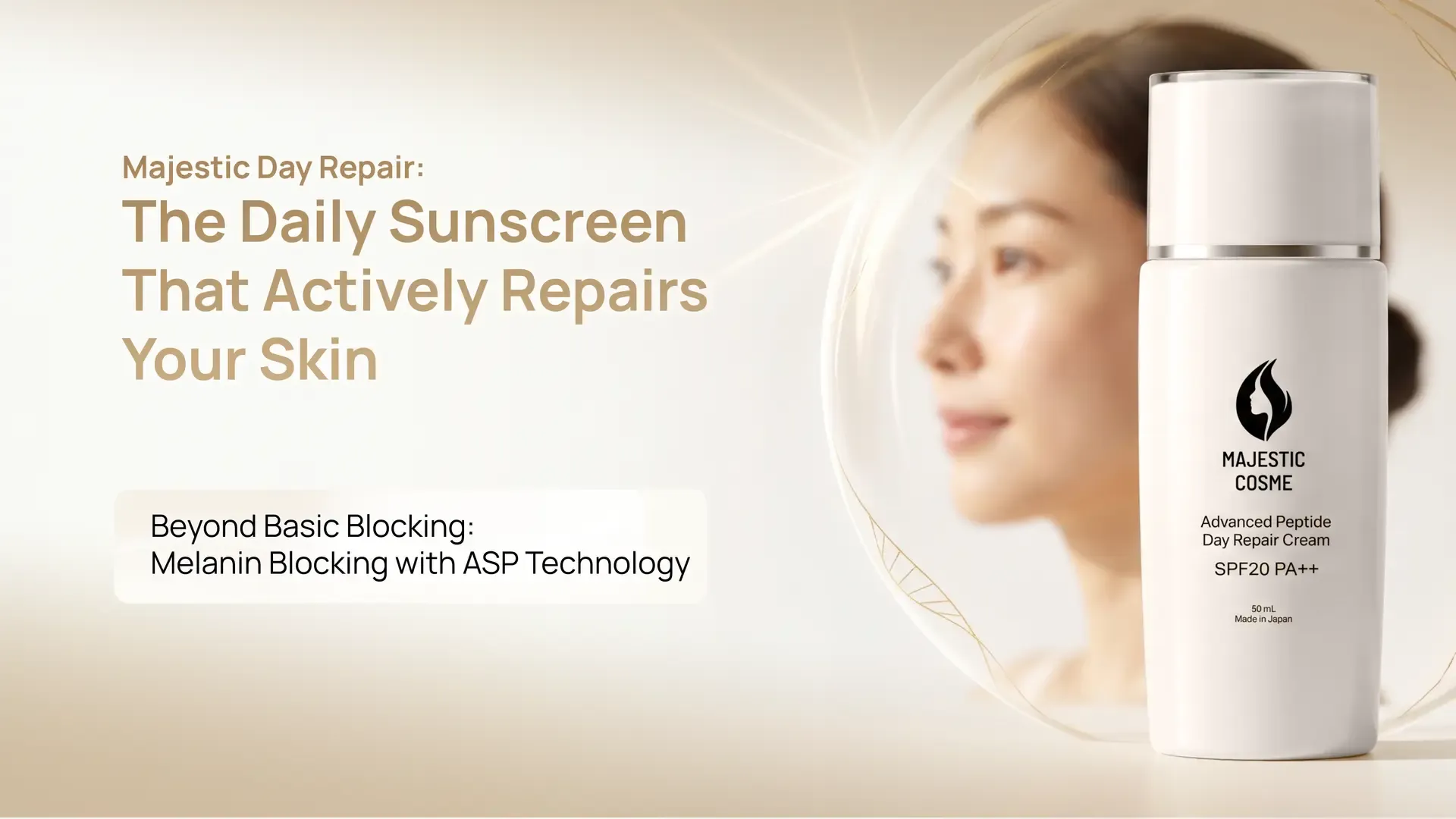
ASP (Anti-Spot Peptide, delivered as Aspartyl Stearate) intercepts this command before it reaches the melanocyte receptor. No instruction reaches the cell, so no excess melanin is produced from that exposure. This is a meaningfully different mechanism from a brightening serum, which works downstream on pigment that has already formed. ASP works upstream, before the pigment is ever made. The same alpha-MSH pathway also triggers matrix metalloproteinases (MMPs), the enzymes responsible for breaking down collagen, so intercepting the signal reduces both new pigmentation and collagen degradation through a single mechanism.
HSP70 and HSP27 are the two heat shock proteins most relevant to UV-stressed skin. HSP70 is a generalist chaperone that handles a wide range of misfolded proteins, particularly within collagen-producing fibroblasts under sustained UV stress. HSP27 maintains the cell's internal scaffolding and prevents the kind of protein clumping that leads to cell death. Research published in the Journal of Photochemistry and Photobiology B established that HSP expression following UV exposure is a direct, measurable indicator of how well skin recovers from that exposure — and HSP efficiency is known to decline with age, which is part of why age spots become more frequent and more persistent later in life.
The Fourth Layer: Biopeptide Collagen Signaling
Mineral UV filtering, DNA repair enzymes, and ASP signal-blocking address three separate problems: incoming damage, existing cellular lesions, and pigmentation. None of the three directly instructs skin to rebuild its structural proteins. That is the job of the biopeptide complex layered into Majestic Day Repair Cream.
Peptides are short amino acid chains that act as biological messengers. When delivered to the dermis at effective concentrations, specific peptide sequences signal fibroblasts, the cells responsible for producing collagen and elastin, to sustain that production. This matters specifically in a daytime UV product because UV exposure activates the same matrix metalloproteinases described above, which actively break down existing collagen. A product that only blocks UV slows new degradation. Pairing that with peptide signaling gives skin an active reason to rebuild what daily UV stress is otherwise wearing down.
Daily Application: Getting the Most From a DNA Repair Formula
A mineral UV formula this dense doubles as a smooth, primer-like base, so it is worth using correctly rather than as an afterthought before makeup.
- Cleanse and apply any water-based serums or treatments first, letting each absorb fully before the next step.
- Apply a pea-sized amount evenly across the face and neck as the final skincare step, using upward strokes.
- Allow 60 seconds for the mineral layer to settle before applying makeup.
- Reapply after two or more hours of direct sun exposure; one morning application is sufficient for ordinary indoor/outdoor days. Benefits compound with consistent daily use — surface improvements typically appear within 4-6 weeks, with deeper structural benefits building over 12 weeks.
Beyond Sunscreen: How Age Spots Treatment Gets Preventative
One of the most visible signs of accumulated UV exposure is hyperpigmentation. Age spots, solar lentigines, and uneven skin tone are not inevitable features of aging, they are, in large part, the skin response to years of UV triggered melanin signaling.
When UV radiation damages keratinocytes, these cells release signals (primarily alpha-melanocyte stimulating hormone, or alpha-MSH) that instruct melanocytes to produce more melanin. This is the body's natural attempt to shield DNA from further damage. Over time, however, this process becomes dysregulated, leading to the clustered pigmentation we associate with older looking skin.
| Approach | Mechanism | Limitation |
|---|---|---|
| Standard sunscreen | Blocks UV before it reaches skin | No effect on existing pigmentation |
| Brightening actives (Vitamin C, niacinamide) | Inhibit melanin synthesis after the signal | Downstream correction only |
| DNA repair + ASP technology | Repairs DNA lesions before the melanin signal is sent | Requires consistent use over time |
Advanced age spots treatment goes upstream of the pigmentation process entirely. ASP (Anti Spot Peptide) technology works by reducing the UV damaged cell's distress signal, which means fewer melanocytes are told to overproduce melanin in the first place. Combined with DNA repair enzymes that remove the underlying lesion, this approach addresses hyperpigmentation preventatively, before it forms, rather than purely correctively after spots appear. This upstream model represents a significant shift in how we think about pigmentation management and long term skin tone evenness.
Choosing the Best Sunscreen with DNA Repair Technology
Not all products that reference repair in their marketing actually contain clinically validated DNA repair ingredients. When evaluating a sunscreen with DNA repair claims, look for the following:
- Photolyase or plankton-derived DNA repair enzymes listed among active or functional ingredients
- Liposomal encapsulation technology to ensure enzyme delivery to the epidermal layer
- Mineral UV filters (zinc oxide or titanium dioxide) for photostable, broad spectrum UV blocking
- Heat Shock Protein-stimulating ingredients such as fermented thermophile extracts
- Absence of fragrance and high-sensitization preservatives, which can compromise barrier function
- Clinical testing references, ideally peer-reviewed, demonstrating CPD reduction in vivo
Japanese skincare technology has long set the benchmark for formulation precision and safety testing in this space. Mineral UV filters deserve particular emphasis here. Unlike some organic UV absorbers that degrade on sun exposure and may generate free radicals as a byproduct, zinc oxide and titanium dioxide remain stable and do not penetrate the skin barrier. When combined with DNA repair enzymes, mineral UV filters create a true two-stage system: block what you can, repair what gets through. For a formulation that brings these principles together in a daily ritual, mineral-based UV protection with DNA repair enzymes represents the current standard in science-led photoprotection.
Frequently Asked Questions
Conclusion: The Future of Sun Protection is Regenerative
The next chapter of sun protection science is not about higher SPF numbers. It is about what happens to the skin beyond the point where UV filters stop. Decades of photolesion accumulation do not reverse themselves when you start wearing sunscreen. They require active intervention at the cellular level.
DNA repair skincare represents that intervention. By combining photostable mineral UV filters with clinically validated repair enzymes, heat shock protein activation, and intelligent melanin signal management, the most advanced anti aging day cream formulations now address both the cause and the consequence of UV exposure in a single morning step.
Majestic Day Repair Cream
Your skin's natural repair capacity is remarkable, but it doesn't have to work alone. Every hour of sunlight leaves its mark, but for the first time in dermatological history, you can do more than just hide from it.
By uniting advanced Japanese Mineral UV Cut filters with high-potency DNA repair enzymes and ASP signal-blocking technology, we’ve created a formula that shields your cells while actively fixing the backlog of damage from seasons past. Turn your morning routine into a professional-grade restorative ritual.
Scientific Sources
- Stege, H. et al. (2000). "Efficacy of T4 endonuclease V and CPD-photolyase in the removal of UV-induced DNA damage." Journal of Investigative Dermatology.
- Yarosh, D. B. et al. (2001). "Effect of topically applied T4 endonuclease V in liposomes on skin cancer in xeroderma pigmentosum." The Lancet.
- Marchetti, M. A. et al. (2004). "Repair of cyclobutane pyrimidine dimers in human skin in vivo." Photochemistry and Photobiology.
- Grether-Beck, S. et al. (2014). "Photoprotection of human skin beyond ultraviolet radiation." Photodermatology, Photoimmunology and Photomedicine.
- Sklar, L. R. et al. (2012). "Use of sunscreens and the association with melanoma and non-melanoma skin cancer." Dermatologic Therapy.