.png?alt=media&token=78c23398-5711-460d-b21c-4a7177094ae4)
Collagen Architecture: Restoring Fibroblast Vitality via High-Concentration ADSC-CM
Table of Contents
- Introduction
- The Science Behind Collagen Loss
- Japanese Stem Cell Technology Breakthrough
- Why Essential for Skin Longevity
- What to Look for in a Premium Serum
- Integrating into Your Routine
The reason is biology. Collagen production in the skin declines by approximately 1% every year after the age of 20. By the time most people notice visible changes, they have already lost a meaningful portion of the structural protein that gives skin its firmness, elasticity, and resilience. Surface-level creams and conventional serums have never been able to address this decline at its source.
Japanese stem cell technology has changed the equation. By working at the cellular level, specifically by signaling the fibroblasts responsible for collagen synthesis, a new generation of collagen production serum is achieving results that were previously only possible in clinical settings. This guide explains the science, the standards to look for, and how to make it work in your daily routine.
The reason is biology. Collagen production in the skin declines by approximately 1% every year after the age of 20. By the time most people notice visible changes, they have already lost a meaningful portion of the structural protein that gives skin its firmness, elasticity, and resilience. Surface-level creams and conventional serums have never been able to address this decline at its source.
Japanese stem cell technology has changed the equation. By working at the cellular level, specifically by signaling the fibroblasts responsible for collagen synthesis, a new generation of collagen production serum is achieving results that were previously only possible in clinical settings. This guide explains the science, the standards to look for, and how to make it work in your daily routine.
The Science Behind Collagen Loss and Why Traditional Serums Fall Short
Collagen is not simply a moisturising agent. It is the primary structural protein of the dermis, forming a dense meshwork of fibres that supports the skin's surface from below. As collagen fibres break down and fibroblast activity slows, the skin loses its ability to bounce back. Fine lines deepen into wrinkles, pores enlarge, and the overall surface texture becomes uneven.
Several factors accelerate this process beyond natural aging. UV exposure triggers the release of matrix metalloproteinases (MMPs), enzymes that actively degrade collagen fibres. Chronic stress elevates cortisol, which suppresses collagen synthesis. Pollution, poor sleep, and nutritional deficiencies each contribute further.
The failure of most conventional serums lies in where they operate. The majority of products on the market, including many marketed as collagen serums, work exclusively in the epidermis, the outermost layer of skin. They hydrate, they smooth, and they temporarily plump. But collagen synthesis happens in the dermis, several layers deeper. Applying a product that cannot penetrate to that level is like trying to repair a building's foundations by repainting the front door.
A genuine collagen production serum must do more than sit on the surface. It must carry bioactive signals deep enough to reach fibroblasts and stimulate them to produce new collagen from within. That is precisely what ADSC-CM technology achieves.
Japanese Stem Cell Technology: The Breakthrough in Collagen Production Serum
The active component in Majestic Skin is adipose-derived stem cell conditioned medium, known as ADSC-CM. To understand why this represents a genuine breakthrough, it helps to follow the biological pathway from source to skin.
Where ADSC-CM comes from
Adipose-derived stem cells are harvested from human fat tissue. In the body, these cells serve as first responders to tissue damage. When injury occurs, they migrate to the affected area and orchestrate repair by releasing a complex mixture of growth factors, cytokines, and signaling peptides. These molecules do not repair tissue directly. Instead, they issue instructions to the surrounding cells, including fibroblasts, directing them to proliferate and increase collagen output.
In a Japanese laboratory, these stem cells are cultured under controlled pharmaceutical-grade conditions. The cells are then removed from the culture medium, leaving behind only the bioactive compounds they have secreted. This conditioned medium is purified, concentrated, and incorporated into a serum formulation at a level of 20%, a concentration that places it firmly at the clinical end of what is commercially achievable.
What happens when it reaches your skin
ADSC-CM penetrates beyond the epidermis, carrying its growth factor payload into the dermis where fibroblasts reside. The growth factors, including EGF (Epidermal Growth Factor), bFGF (basic Fibroblast Growth Factor), and TGF-beta, bind to receptors on the fibroblast surface and trigger a cascade of cellular activity.
Fibroblasts increase their production of collagen type I and type III, the two primary structural collagens in adult skin. They also produce elastin and hyaluronic acid, reinforcing the entire extracellular matrix simultaneously.
For a broader look at how this technology compares to professional clinical procedures, including laser resurfacing and PRP therapy, see our detailed guide on Clinical-Level Skin Treatment.
Why Collagen Production Serum Is Essential for Skin Longevity
The conversation around skincare has shifted in 2026. The dominant goal is no longer how to look younger overnight. It is how to maintain the structural integrity of skin over time, minimising decline rather than simply masking it. This is the principle of skin longevity, and it changes which products deserve a place in a daily routine.
| Approach | Mechanism | Duration | Builds Collagen | Ongoing Cost |
|---|---|---|---|---|
| Filler Injections | Volumises with HA | 6 - 12 months | No | High |
| Laser Resurfacing | Controlled injury triggers repair | 1 - 2 years | Indirectly | Very high |
| Retinoid Cream | Upregulates collagen gene expression | Ongoing | Moderate | Low - moderate |
| ADSC-CM Serum (20%) | Signals fibroblasts via growth factors | Ongoing | Yes, directly | Moderate |
A collagen production serum that genuinely stimulates fibroblast activity is doing something fundamentally different. It is not filling a gap. It is asking the skin to produce more of what it is losing. Over consistent use, this approach creates a compounding benefit: more collagen synthesised each month means a slower net decline, better texture, and more even tone.
Integrating Collagen Production Serum into Your Routine
Layering order
- Cleanse thoroughly to remove any barrier between the serum and the skin.
- Apply the ADSC-CM serum to slightly damp skin immediately after cleansing.
- Allow two to three minutes for absorption before applying any subsequent products.
- Follow with a peptide moisturiser or barrier cream to seal the actives in place.
- Apply SPF 30 or higher every morning without exception. UV exposure degrades newly synthesised collagen.
Realistic timeline for visible results
- Weeks 1 - 2: Skin hydration and surface texture begin to improve.
- Weeks 4 - 6: Fibroblast activity increases and early collagen remodelling begins.
- Weeks 8 - 12: Meaningful structural changes become visible, including improved skin firmness.
- Month 6 onward: Continued use compounds the cumulative effect on the skin's collagen framework.
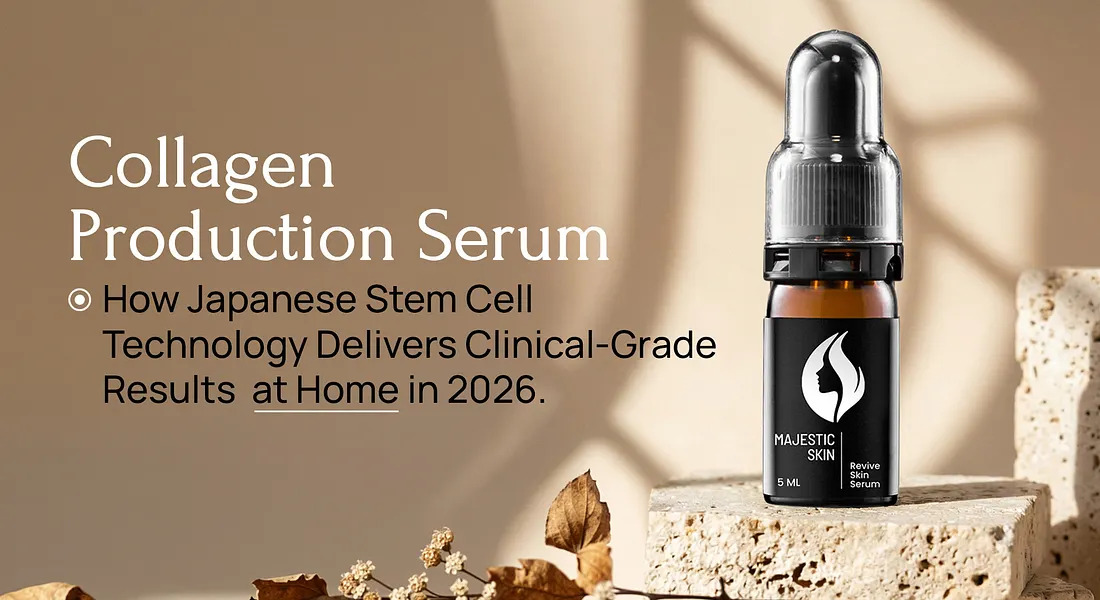
Majestic Skin Collagen Production Serum
Formulated with 20% human ADSC-CM in a Japanese pharmaceutical-grade laboratory. Built for those who want genuine collagen stimulation and visible structural results.
Shop Majestic Skin NowFrequently Asked Questions
Sources
- El-Domyati, M., et al. (2002). "Intrinsic aging vs. photoaging." Experimental Dermatology.
- Hassan, W. U., et al. (2020). "Role of adipose-derived stem cells and their conditioned medium in skin rejuvenation." Skin Pharmacology and Physiology.
- Shin, H., et al. (2021). "Human adipose tissue-derived mesenchymal stem cells exert anti-aging properties." Biomolecules.
- Quan, T., & Fisher, G. J. (2015). "Role of age-associated alterations of the dermal extracellular matrix." Gerontology.
- Sriram, G., et al. (2021). "Fibroblast heterogeneity and skin models." European Journal of Cell Biology.