.png?alt=media&token=78c23398-5711-460d-b21c-4a7177094ae4)

The Cellular Breakdown: Reactivating Dermal Scaffolding at the Signal Source
Table of Contents
- Introduction
- The Cellular Breakdown: Where Collagen Loss Really Begins
- Why Surface Treatments Fail to Address the Source
- The Regenerative Approach: Restoring Cellular Signals
- Why Majestic Skin Targets Collagen Production at the Source
- How to Use Majestic Skin for Maximum Results
When we think about aging skin, we often focus on what we can see: wrinkles, sagging, loss of firmness. But the real story of aging begins much deeper, at a level invisible to the naked eye. Collagen loss does not start at the surface. It starts at the cellular level, in the intricate biological machinery that produces and maintains the skin's structural foundation.
Understanding where and why collagen production slows down is essential to addressing aging effectively. For decades, the skincare industry has focused on hydration, exfoliation, and surface-level treatments. While these approaches offer temporary benefits, they do not restore the skin's ability to produce collagen on its own.
Majestic Skin by Majestic Cosme represents a fundamentally different approach. Formulated with 20% human stem cell conditioned media (ADSC-CM), it works at the source of collagen decline by delivering the biological signals that reactivate fibroblast activity and restore the skin's natural repair processes. This article explains what happens when collagen production slows down at the cellular level and how advanced collagen production serum technology addresses the root cause of aging.
Introduction
When we think about aging skin, we often focus on what we can see: wrinkles, sagging, loss of firmness. But the real story of aging begins much deeper, at a level invisible to the naked eye. Collagen loss does not start at the surface. It starts at the cellular level, in the intricate biological machinery that produces and maintains the skin's structural foundation.
Understanding where and why collagen production slows down is essential to addressing aging effectively. For decades, the skincare industry has focused on hydration, exfoliation, and surface-level treatments. While these approaches offer temporary benefits, they do not restore the skin's ability to produce collagen on its own.
Majestic Skin by Majestic Cosme represents a fundamentally different approach. Formulated with 20% human stem cell conditioned media (ADSC-CM), it works at the source of collagen decline by delivering the biological signals that reactivate fibroblast activity and restore the skin's natural repair processes. This article explains what happens when collagen production slows down at the cellular level and how advanced collagen production serum technology addresses the root cause of aging.
The Cellular Breakdown: Where Collagen Loss Really Begins
Collagen is the most abundant structural protein in the skin, accounting for approximately 70% of the dermis. It provides firmness, resilience, and structural support. But collagen does not simply exist in the skin. It is actively produced by specialized cells called fibroblasts.
As we age, fibroblast activity declines. These cells become less responsive to the biological signals that normally instruct them to produce collagen and elastin. At the same time, the production of key signaling molecules, such as growth factors like EGF (epidermal growth factor) and FGF (fibroblast growth factor), decreases significantly.
This creates a dual problem. Collagen production slows while existing collagen continues to degrade through a process called enzymatic breakdown, mediated by enzymes such as matrix metalloproteinases (MMPs). The result is a net loss of structural integrity. The skin becomes thinner, less firm, and more prone to visible signs of aging such as fine lines, wrinkles, and sagging.
Key factors in cellular-level collagen decline include:
- Reduced fibroblast proliferation and activity with age
- Decreased production of growth factors that signal collagen synthesis
- Increased activity of collagen-degrading enzymes
- Weakened cellular communication and repair coordination
- Decline in the skin's regenerative capacity over time
This is why collagen loss is not simply a matter of needing more moisture or exfoliation. It is a failure of the biological system that produces and maintains collagen in the first place.
Why Surface Treatments Fail to Address the Source
Most traditional skincare products focus on what happens at the surface of the skin. Moisturizers add hydration. Exfoliants remove dead cells. Antioxidants protect against environmental damage. These are all valuable functions, but they do not restore the skin's ability to produce collagen.
Even products that claim to contain collagen often fail to deliver meaningful results. Topical collagen molecules are too large to penetrate the skin barrier and reach the dermis where collagen resides. Applying collagen to the surface does not signal fibroblasts to produce more collagen internally.
This is the fundamental limitation of surface-level approaches. They may improve the appearance of skin temporarily, but they do not address the underlying cause of aging: the decline in cellular signaling and fibroblast activity that drives collagen production.
| Approach | Primary Mechanism | Limitation |
|---|---|---|
| Topical Collagen | Applies collagen molecules to skin surface | Molecules too large to penetrate; no internal signal |
| Hyaluronic Acid | Attracts and retains moisture for plumping | Temporary hydration; no collagen restoration |
| Retinol | Accelerates cell turnover and signals collagen | Potential irritation; primarily surface renewal |
| Peptides | Short chains of amino acids for signaling | Limited penetration; variable efficacy |
| Human Stem Cell Serum | Delivers growth factors for cell signaling | Requires high-quality formulation and potency |
To truly address collagen decline, a treatment must work at the cellular level by restoring the biological signals that coordinate collagen production and skin repair.
The Regenerative Approach: Restoring Cellular Signals
Advanced regenerative skincare works by addressing the root cause of collagen decline: the loss of cellular signaling. When fibroblasts receive the correct biological instructions, they respond by producing more collagen, elastin, and other structural proteins.
This is where human stem cell serum technology becomes essential. Stem cells naturally secrete a complex mixture of growth factors, cytokines, and signaling proteins that coordinate tissue repair and regeneration. When these bioactive molecules are delivered topically through advanced formulations, they communicate with the skin's existing cells and reactivate dormant repair processes.
Key growth factors involved in collagen production include:
- EGF (Epidermal Growth Factor): Stimulates cell proliferation and wound healing
- FGF (Fibroblast Growth Factor): Directly signals fibroblasts to produce collagen
- TGF-beta (Transforming Growth Factor): Regulates extracellular matrix production
- VEGF (Vascular Endothelial Growth Factor): Supports nutrient delivery and tissue health
- IGF (Insulin-like Growth Factor): Promotes cell survival and proliferation
By delivering these signaling molecules directly to the skin, regenerative human stem cell technology restores the cellular communication network that declines with age. Fibroblasts receive clear instructions to repair, regenerate, and produce collagen. This is not a temporary fix. It is a restoration of the skin's natural biological function.
Why Majestic Skin Targets Collagen Production at the Source
Not all stem cell serums are formulated equally. The difference between a product that delivers results and one that simply carries a label comes down to concentration, quality, and delivery technology.
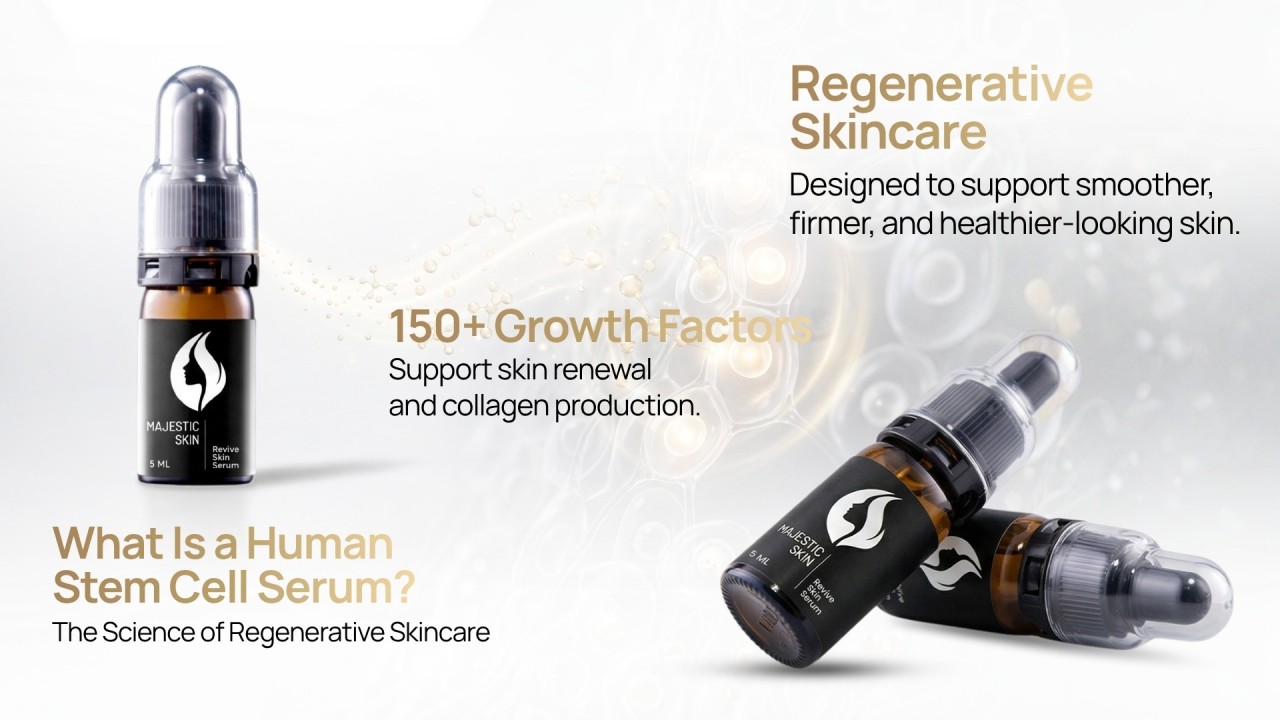
Majestic Skin is formulated with 20% human adipose-derived stem cell conditioned media (ADSC-CM), one of the highest concentrations available in consumer skincare. This is not a diluted extract. It is a clinically relevant dose of over 150 verified growth factors designed to restore fibroblast activity and stimulate collagen production at the source.
What sets Majestic Skin apart:
- Ultra-high concentration (20%) of ADSC-CM verified for potency
- Liposome delivery technology that supports deep dermal penetration
- Cold process formulation that preserves bioactive integrity
- Pharmaceutical-grade Japanese manufacturing with rigorous quality control
- Fragrance-free, sensitizer-free base suitable for all skin types
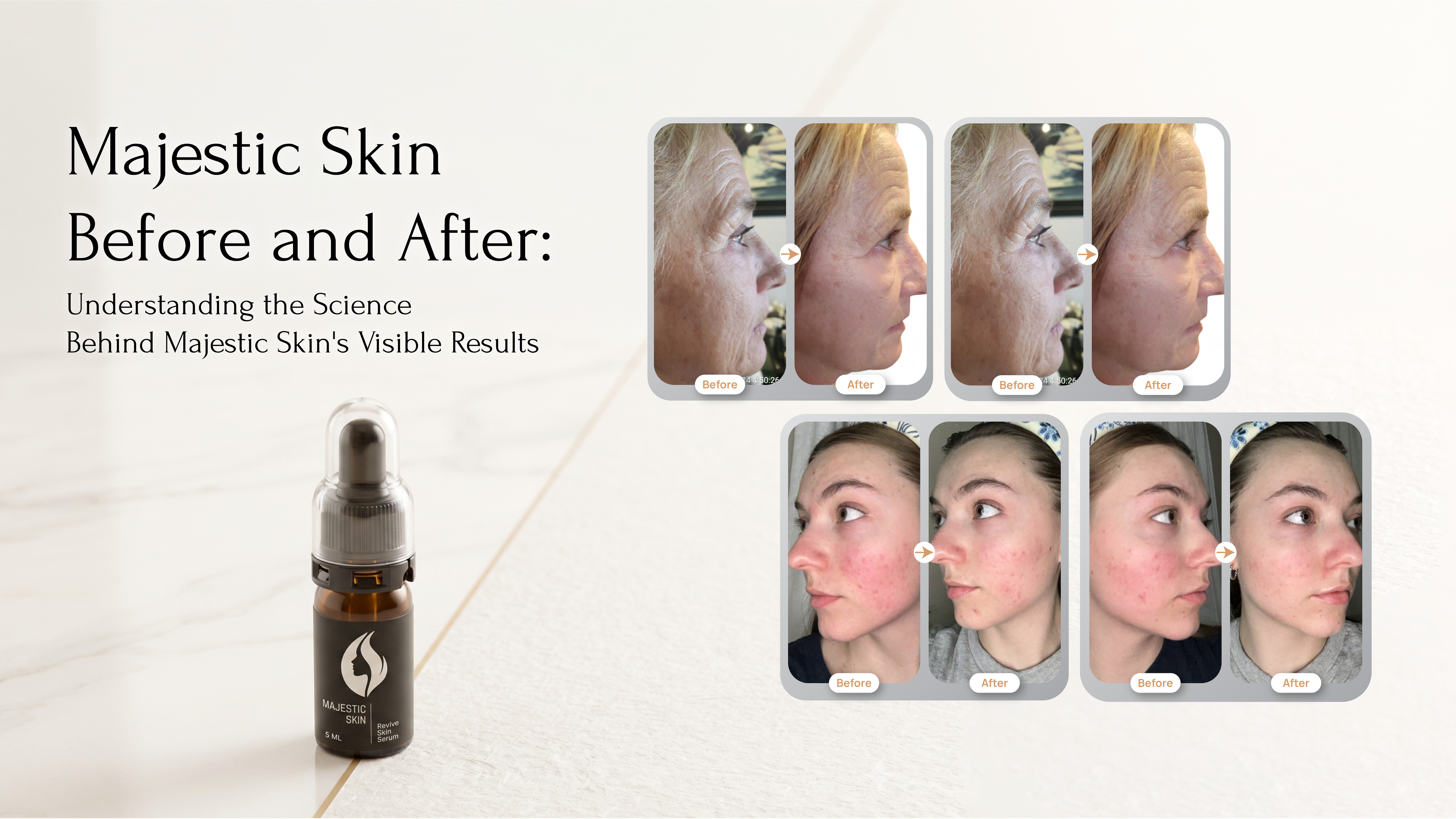
Users consistently report visible improvements in skin firmness, texture, and radiance within the first few weeks of use. Structural improvements such as increased collagen density and wrinkle reduction become noticeable from week four onward. Long-term use supports the skin's ongoing ability to maintain collagen production and structural integrity.
This approach goes beyond temporary cosmetic results. By reactivating the skin's natural repair processes, it helps restore the biological foundation of healthy, resilient skin. Explore the full range of formulations designed around this principle in the advanced stem cell skincare collection.
How to Use Majestic Skin for Maximum Results
Achieving meaningful results from a regenerative serum requires consistent and correct application. For Majestic Skin, the routine is straightforward and integrates easily into any skincare regimen.
Apply 2 to 3 drops to clean, slightly damp skin in the morning and evening. Gently press the serum into the skin with your fingertips rather than rubbing. This technique supports even absorption and maximizes the bioavailability of growth factors. Follow with a moisturizer to lock in the active ingredients.
If you use other serums, apply Majestic Skin after water-based products and before heavier oils or occlusive creams. If you use retinol, consider applying Majestic Skin in the morning and your retinoid in the evening to minimize potential overlap.
For optimal results, follow the recommended 14-day intensive treatment cycle. This concentrated approach accelerates your skin's natural renewal process from the standard 28-day cycle to just 14 days. To complete the full cycle, you will need 3 bottles of Majestic Skin (5ml each).
Expected timeline for collagen production improvements:
- Week 1 to 2: Improved skin texture, enhanced hydration, early signs of cellular renewal
- Week 2 to 4: Visible reduction in fine lines and improved radiance
- Week 4 to 8: Measurable increase in firmness and deeper wrinkle reduction
- 3 months and beyond: Sustained collagen improvements and long-term structural benefits
Consistency is essential. Because growth factors work by stimulating the skin's own repair systems, benefits build cumulatively rather than appearing instantly.
Reactivate Internal Fibroblast Integrity
Avoid superficial volume masking. Instruct your own cells to synthesize high-density native collagen chains via Majestic Skin.
Discover Majestic SkinFrequently Asked Questions
Clinical Sources
- Fisher, G.J., et al. (2002). "Mechanisms of photoaging and chronological skin aging." Archives of Dermatology.
- Varani, J., et al. (2006). "Decreased collagen production in chronologically aged skin." American Journal of Pathology.
- Stem Cell Research and Therapy. (2021). "Human mesenchymal stem cell-derived conditioned media."
- Journal of Cosmetic Dermatology. (2022). "Mesenchymal stem cell-conditioned media exosomes."
- Quan, T., and Fisher, G.J. (2015). "Role of age-associated alterations of the dermal extracellular matrix." Gerontology.