.png?alt=media&token=78c23398-5711-460d-b21c-4a7177094ae4)
The Regenerative Baseline: Human ADSC-CM Potency and Dermal Layer Renewal
Clinical Guide
- Philosophies of Anti-Aging
- Science of ADSC-CM Regeneration
- Beyond Temporary Results
- Botox: Short-Term Fix vs. Health
- Majestic Skin Clinical Efficacy
- Investment in Cellular Wellness
- Frequently Asked Questions
- Academic References
The decision between Botox and a stem cell face serum is, at its core, a decision between two different philosophies of anti-aging. One aims to manage the appearance of aging skin by suppressing the muscle movement that creates expression lines. The other aims to restore the biological conditions in which skin regenerates, produces structural proteins, and resists visible aging from within. These are not variations of the same approach. They are fundamentally different definitions of what anti-aging treatment is supposed to achieve.
Botox has dominated the aesthetic treatment market for two decades, and for a specific indication, deep dynamic wrinkles caused by repeated muscle contraction, it remains the most direct available solution. But for the broader population of people seeking a clinical anti-aging outcome without injections, the evidence for human stem cell serum technology has matured to the point where it now represents a genuinely superior alternative for most presentations of skin aging.
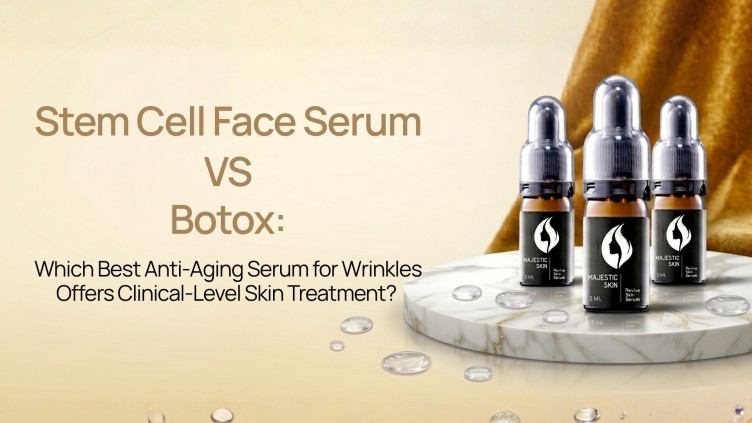
This article examines both approaches with scientific precision, presents the clinical evidence, and makes the case for why Majestic Skin Serum's 20% ADSC-CM technology represents the most advanced non-invasive wrinkle treatment available to consumers in 2026.
Botox has dominated the aesthetic treatment market for two decades, and for a specific indication, deep dynamic wrinkles caused by repeated muscle contraction, it remains the most direct available solution. But for the broader population of people seeking a clinical anti-aging outcome without injections, the evidence for human stem cell serum technology has matured to the point where it now represents a genuinely superior alternative for most presentations of skin aging.
This article examines both approaches with scientific precision, presents the clinical evidence, and makes the case for why Majestic Skin Serum's 20% ADSC-CM technology represents the most advanced non-invasive wrinkle treatment available to consumers in 2026.
Understanding the Science: How ADSC-CM Ignites Skin Regeneration
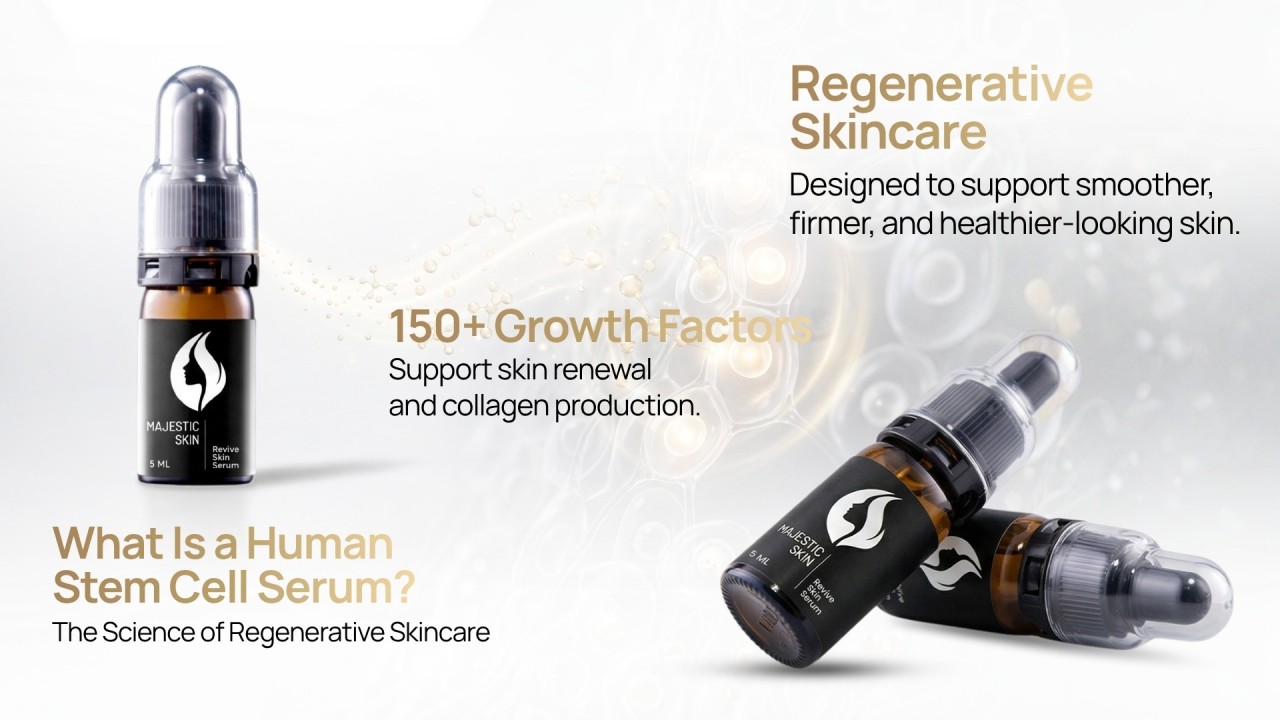
ADSC-CM is adipose-derived stem cell conditioned medium. It is produced by culturing human adipose stem cells under pharmaceutical-grade GMP conditions in Japan. After the cultivation period, the cells are removed. What remains is a complex biological fluid, the conditioned medium, containing the full secretory output of those cells: over 150 growth factor proteins, cytokines, and signaling peptides.
This is not a synthetic approximation of biological signaling. It is the actual molecular signal that human stem cells produce when coordinating tissue repair. Applied topically at 20% concentration through Liposome Technology, it delivers that signal to fibroblasts in the dermis, where structural skin proteins are produced. Fibroblasts are the dermal cells responsible for collagen, elastin, and hyaluronic acid synthesis. As skin ages, fibroblast activity declines by approximately 1% per year from the age of twenty.
ADSC-CM growth factors bind to specific receptors on fibroblast surfaces and trigger the cellular activity that age and biological decline have diminished. FGF drives collagen type I and III synthesis directly. EGF accelerates keratinocyte turnover at the surface. TGF-beta regulates the balance between collagen production and the enzymes that degrade it. VEGF improves dermal oxygenation. IGF promotes cell proliferation across multiple skin cell populations. Clinical data shows Majestic Skin's formula induces a larger volume of hyaluronan expression than even positive control groups treated with isolated growth factors.
Beyond Temporary: The Regenerative Power of Human Stem Cells
The defining characteristic of ADSC-CM technology as an anti-aging serum for wrinkles is that its results are not temporary and do not reset. Each 14-day treatment cycle produces structural changes in the dermis that persist and compound with subsequent cycles. Majestic Skin's 14-day intensive treatment protocol reflects the accelerated renewal rate that 20% ADSC-CM produces. The skin's natural turnover cycle takes approximately 28 days. The growth factor cascade triggered by the formula activates fibroblasts and keratinocytes to operate at roughly double the normal pace, completing a meaningful structural renewal cycle in 14 days.
The compounding nature of the results is what separates a regenerative approach from a maintenance approach. Botox must be repeated every three to five months and produces no lasting structural benefit. Each cycle of Majestic Skin builds on the collagen density established in the previous cycle. At six months of consistent use, the skin's structural foundation is meaningfully stronger than at the start, not the same as before treatment began.
For a broader look at how human stem cell serums compare to other trending anti-aging ingredients including PDRN, the detailed guide on PDRN vs human stem cell serum examines each mechanism and its clinical evidence base.
Botox: A Short-Term Fix vs. Lasting Cellular Health
Botulinum toxin, the active compound in Botox, works by blocking the acetylcholine neurotransmitter that triggers specific facial muscle contractions. The result is temporary relaxation of those muscles, which reduces the depth of dynamic expression lines. This mechanism is precise, predictable, and entirely unrelated to skin biology.
- Botox does not stimulate collagen production. It does not improve skin texture, elasticity, or pigmentation. It has no effect on skin hydration or barrier function.
- The muscles relax for three to five months and then resume their normal activity. The wrinkles that were suppressed return at the same depth and in the same location as before treatment.
- Collagen continues to decline during the period of Botox use. The structural deficit in the dermis grows even as the surface appearance is temporarily managed by muscle paralysis.
- Annual cost for full-face maintenance in the US typically runs between $2,400 and $4,800, with no cumulative structural benefit at any point in the treatment history.
- Overuse produces the characteristic frozen aesthetic, which reflects the suppression of natural muscle movement rather than any improvement in skin quality.
| Factor | Botox | Majestic Skin Serum (20% ADSC-CM) |
|---|---|---|
| Mechanism | Temporary muscle paralysis | Fibroblast activation via 150+ growth factors |
| Collagen building | None | Direct, via FGF and TGF-beta |
| Skin texture improvement | None | Yes, via EGF and dermal renewal |
| Addresses pigmentation | No | Yes, via TGF-beta activity |
| Results are cumulative | No, full reset every 3-5 months | Yes, compound with each cycle |
| Sensitive skin compatible | Generally | Yes, no inflammatory mechanism |
| Downtime | 1 to 3 days | None |
| Clinic visits required | Yes, every treatment | No |
| Annual cost (US) | $2,400 to $4,800+ | From $150 per 14-day cycle |
| Regulatory registration | FDA approved drug | JCIA, BPOM, FDA process |
There are also common misconceptions about what stem cell serum technology can and cannot do. For a science-based examination of those claims, the article on stem cell technology skincare myths debunked addresses the most frequent misunderstandings with peer-reviewed evidence.
Majestic Skin Serum: Clinical Efficacy for True Anti-Aging
Majestic Skin Serum is registered with the Japan Cosmetic Industry Association (JCIA), approved by Indonesia's BPOM, and currently undergoing FDA review. It is produced in a Japanese pharmaceutical-grade laboratory under GMP conditions. The 20% ADSC-CM concentration represents one of the highest commercially available levels from a source meeting this standard. Most ADSC-CM products on the market fall between 1% and 10%. The clinical evidence for structural dermal change is concentrated at the higher concentration levels, which is why the 20% figure matters beyond marketing positioning.
Choosing Your Path to Youth: Investment in Cellular Wellness
The investment comparison between Botox and a human stem cell serum is not simply a price-per-session calculation. It is a question of what each year of investment produces biologically and cumulatively. The choice for consumers who want a non-invasive wrinkle treatment that produces genuine clinical benefit is not between Botox and settling for less. It is between a temporary injectable that resets every few months and a regenerative serum that builds something lasting every time it is used.
Frequently Asked Questions
Majestic Skin Serum
20% ADSC-CM. 150+ growth factors. Liposome deep delivery. The world's first non-invasive regenerative serum powered by genuine human stem cell technology from Japan.
Shop Majestic Skin Serum NowAcademic References
- Shin, H., et al. (2021). "Human adipose tissue-derived mesenchymal stem cells and their secretome exert anti-aging properties in human skin." Biomolecules, 11(11).
- Kober, M., & Berto, G. (2022). "Adipose-derived stem cell conditioned medium in the treatment of facial skin aging." Journal of Cosmetic Dermatology, 21(4).
- Kim, W. S., et al. (2009). "Wound healing effect of adipose-derived stem cells: A critical role of secretory factors on fibroblast collagen synthesis." Journal of Dermatological Science, 55(3).
- Hassan, W. U., et al. (2020). "Role of adipose-derived stem cells and their conditioned medium in skin rejuvenation." Skin Pharmacology and Physiology, 33(2).
- Quan, T., & Fisher, G. J. (2015). "Role of age-associated alterations of the dermal extracellular matrix microenvironment in human skin aging." Gerontology, 61(5).