.png%253Falt%253Dmedia%2526token%253D78c23398-5711-460d-b21c-4a7177094ae4%22%7D%2C%7B%22operation%22%3A%22resize%22%2C%22width%22%3A48%7D%2C%7B%22operation%22%3A%22output%22%2C%22format%22%3A%22webp%22%2C%22quality%22%3A75%7D%5D)
.jpg%253Falt%253Dmedia%2526token%253Dab1a42a1-288f-4887-93c1-b2f9c85cc882%22%7D%2C%7B%22operation%22%3A%22resize%22%2C%22width%22%3A1920%7D%2C%7B%22operation%22%3A%22output%22%2C%22format%22%3A%22webp%22%2C%22quality%22%3A75%7D%5D)
Comparing Human Stem Cell Conditioned Media (ADSC-CM) vs Retinol becomes crucial past age 30, as the skin barrier begins to thin naturally. While retinol effectively accelerates skin turnover, it carries a high risk of causing skin barrier damage, especially in warm, humid climates or constantly air-conditioned environments.
The 30+ Anti-Aging Dilemma: Cellular Regeneration vs. Damaged Skin Barrier Risk
Upon reaching your 30s, natural collagen production drops by approximately 1% each year. Consequently, many women turn to retinol due to its reputation as the gold standard in anti-aging. However, many end up experiencing redness, peeling, and stinging sensations, particularly when living in humid, sunny, or tropical environments where sun exposure and climate changes are intense.
This creates a genuine dilemma. While intensive skin regeneration is essential to combat visible signs of aging, an already weakened skin barrier becomes increasingly vulnerable to damage when exposed to aggressive active ingredients. This reaction is often referred to as "purging," an adaptation phase that is frequently mistaken for a "detox," when in reality it may indicate severe barrier stress. To gain a deeper understanding of how collagen production changes over time, explore our detailed guide on skincare and collagen after age 30.
The core question is no longer which ingredient is stronger, but rather which is smarter for mature skin. This article provides an in-depth analysis of Human Stem Cell Conditioned Media (ADSC-CM) vs Retinol through the lens of skin barrier health, while introducing a Japanese Human Stem Cell Conditioned Media (ADSC-CM) technology solution engineered specifically for cellular regeneration without compromising natural moisture.
Why Are Retinol Rules So Complex? (What Ingredients Should Not Be Mixed with Retinol?)
Retinol is generally not recommended for use alongside AHAs, BHAs, or benzoyl peroxide in the same routine, as these combinations elevate the risk of irritation and accelerate skin barrier damage. Pure vitamin C and retinol should also not be layered simultaneously due to conflicting pH levels, though they can still be used at separate times within the same overall skincare regimen.
One of the greatest challenges of using retinol is navigating its complex application rules. Retinol should not be combined with exfoliating acids such as AHAs (Alpha Hydroxy Acids) or BHAs (Beta Hydroxy Acids), as doing so can cause over-exfoliation and strip away the skin's protective lipid barrier.
Additionally, layering retinol directly with pure vitamin C at the same time is discouraged due to differing pH requirements, which can destabilize the formulas and trigger skin irritation. This does not mean both ingredients must be completely avoided; many dermatologists suggest separating application times, for instance, using vitamin C in the morning for antioxidant protection and retinol at night for nighttime renewal. Furthermore, retinol users must strictly avoid direct sun exposure without broad-spectrum sun protection, as retinol significantly heightens skin photosensitivity.
These complicated restrictions present a notable challenge for women aged 30 and above who seek a straightforward yet highly effective anti-aging routine.
Understanding How Retinol vs Human Stem Cell Conditioned Media (ADSC-CM) Work on Mature Skin
Retinol operates by accelerating epidermal cell turnover through physical shedding and exfoliation. Conversely, Human Stem Cell Conditioned Media (ADSC-CM) (the growth-factor and exosome-rich fluid secreted by adipose-derived stem cells during culture, rather than living cells themselves) functions via cellular signaling, communicating with dermal fibroblasts (the skin's natural collagen factories) to generate fresh collagen without stripping the surface barrier.
Retinol: Epidermal Exfoliation That Risks Thinning the Barrier
Retinol is a vitamin A derivative that accelerates cell turnover, which is the process of shedding dead skin cells to reveal new ones. This mechanism occurs predominantly in the epidermis (the outermost skin layer) by forcing surface cells to shed faster than their natural lifecycle.
In warm or humid environments, rapid exfoliation can cause additional complications. The stratum corneum, which serves as the primary barrier against moisture loss, may thin faster than the skin can repair itself. This increases transepidermal water loss (TEWL), allowing vital moisture to escape from the compromised epidermis.
For women over 30, daily routines often worsen this condition. Moving between dry, air-conditioned indoor spaces and warm outdoor air forces the skin to constantly adapt to extreme humidity fluctuations. When the stratum corneum is thinned by retinol exfoliation, these environmental shifts accelerate moisture depletion, leading to persistent tightness, stinging, and inflammation that are difficult to soothe.
Commonly reported side effects of retinol include visible peeling, redness, stinging, and heightened sensitivity to UV rays. For mature skin with a naturally thinning barrier, these risks are significantly higher than in younger skin.
Modern formulations have advanced to address these vulnerabilities. Encapsulated retinol technology wraps the active molecule in micro-protective carriers for time-released delivery, mitigating harsh surface contact. Micro-dosing approaches at low concentrations (e.g., 0.1%) also help minimize barrier irritation while retaining regenerative benefits. While these innovations make retinol far more tolerable than older formulas, purging and sensitivity risks remain, especially for delicate barriers.
Human Stem Cell Conditioned Media (ADSC-CM): Cellular Signals That Stimulate Natural Collagen Synthesis
Human Stem Cell Conditioned Media (ADSC-CM) (sometimes described as stem cell exosomes or secretome technology) operates through a fundamentally distinct biological pathway from retinol. Rather than applying living cells to the skin, ADSC-CM captures the growth factors, cytokines, and exosomes that adipose-derived stem cells naturally secrete during culture. These biomimetic messengers penetrate beyond the surface layer deep into the dermis, leveraging the body's native biological communication pathways to encourage renewal.
Within the dermis, the growth factors and exosomes present in ADSC-CM interact directly with fibroblasts, which are the cells responsible for producing collagen and elastin. Clinical observations demonstrate that after 14 days of consistent ADSC-CM application, fibroblast proliferation rates increase by up to 83%, triggering measurable structural density without surface trauma.
This makes ADSC-CM a gentler yet potent option that addresses skin aging at its root cause: the decline of cellular collagen production. Because no aggressive surface exfoliation takes place, ADSC-CM formulas do not trigger purging, surface peeling, or adaptation discomfort.
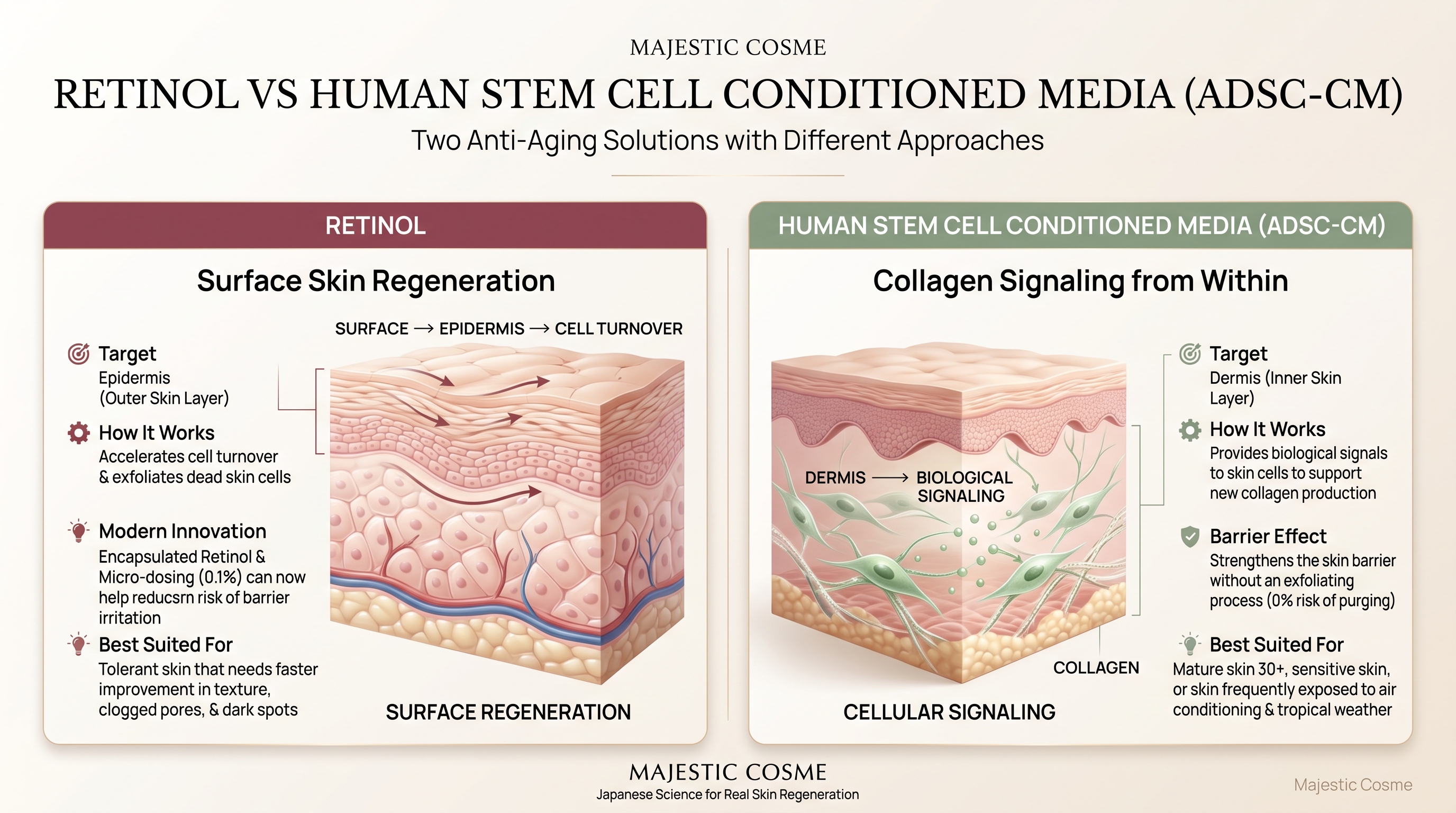
Infographic: Difference in penetration and mechanism of action between Retinol (epidermal exfoliation) and Human Stem Cell Conditioned Media (ADSC-CM) (dermal cellular signaling).
Head-to-Head Comparison: Which Is Gentler on Sensitive Skin Barriers?
Human Stem Cell Conditioned Media (ADSC-CM) is generally more supportive of sensitive skin barriers than retinol, operating without abrasive exfoliation. While retinol delivers faster short-term surface smoothing, ADSC-CM offers superior long-term safety and compatibility for mature skin.
| Aspect | Retinol | ADSC-CM (Stem Cell Exosomes) |
|---|---|---|
| Mechanism of Action | Epidermal exfoliation; accelerates cell turnover | Cellular signaling to dermal fibroblasts |
| Target Layer | Epidermis (surface) | Dermis (deeper layers) |
| Irritation Risk | High, especially in fluctuating climates | Low to minimal |
| Effect on Skin Barrier | Can erode protective lipid barrier | Supports and reinforces barrier integrity |
| Purging Phase | Common (2 to 6 weeks) | Rare or non-existent |
| Photosensitivity | Significantly increased | Not increased |
| Ingredient Compatibility | Restricted; requires careful layering | Highly versatile; easy to layer |
| Ideal for Sensitive Mature Skin | Requires extreme caution | Exceptionally well-suited |
While retinol remains effective for rapid surface refinement, ADSC-CM presents a safer profile for mature skin prone to barrier weakness.
When Is Retinol Still an Appropriate Choice?
Human Stem Cell Conditioned Media (ADSC-CM) and retinol address distinct skin needs. Selecting the right option depends on your specific goals and current barrier health.
For concerns such as rough texture, persistent clogged pores, or hyperpigmentation from past breakouts, retinol often yields quicker visible changes. Its accelerating effect on turnover targets these issues directly, whereas ADSC-CM works progressively via biological cell signaling.
Skin barrier resilience is the deciding factor. If your skin shows no signs of sensitivity or compromise, and you strictly adhere to usage guidelines (including daily broad-spectrum sun protection), retinol can be used effectively. However, if your skin exhibits fragility or reactive tendencies, ADSC-CM provides a safer starting point.
The Japanese Biotechnology Solution: ADSC-CM Without Irritation Side Effects
Human Stem Cell Conditioned Media (ADSC-CM) contains bio-identical growth factors and exosomes secreted by adipose-derived stem cells, matching natural human signaling molecules rather than introducing living cells. This compatibility allows skin cells to recognize and respond to the formula seamlessly, avoiding adverse reactions or irritation.
Not all regenerative formulas share the same precision. Majestic Cosme utilizes advanced Japanese Human Stem Cell Conditioned Media (ADSC-CM) technology to pioneer bio-identical human cellular signaling.
This innovation relies on molecular alignment. Because the growth factors and exosomes within ADSC-CM mirror natural human bio-signals, cell receptors accept the inputs smoothly. Cellular renewal can proceed without triggering sensitization or irritation commonly linked to synthetic ingredients.
Majestic Skin is formulated with a 20% concentration of Human Stem Cell Conditioned Media (ADSC-CM), delivering high potency within advanced regenerative serums. In clinical evaluation over 12 weeks of continuous twice-daily application, subjects achieved an average of 41.7% reduction in measured wrinkle depth.
This approach aligns with Japanese beauty standards: achieving supple, hydrated, resilient skin ("mochi skin") from within, rather than exposing the barrier to excessive exfoliation.
How to Incorporate an Anti-Aging Human Stem Cell Conditioned Media (ADSC-CM) Serum into Your Daily Skincare Routine
A Human Stem Cell Conditioned Media (ADSC-CM) serum can be applied morning and night after cleansing and prior to moisturizing. It pairs well with ingredients like hyaluronic acid, niacinamide, and daily sunscreen without negative interactions.
A main advantage of ADSC-CM over retinol is its ease of integration into daily routines. Follow these recommended application steps:
Morning Routine: After cleansing, press 2 to 3 drops of your Human Stem Cell Conditioned Media (ADSC-CM) serum onto damp skin. Follow with a moisturizer and finish with sunscreen for comprehensive daily anti-aging protection.
Evening Routine: Apply the serum again following double cleansing. Because ADSC-CM formulas do not increase photosensitivity, they can be used consistently night after night without sun sensitivity concerns.
Unlike retinol, a Human Stem Cell Conditioned Media (ADSC-CM) serum mixes easily with hyaluronic acid for hydration, niacinamide for barrier support, and vitamin C for morning antioxidant benefits. For further guidance on product textures, consult our overview on the differences between anti-aging serums and creams.
For best results, use consistently over 8 to 12 weeks to support the natural collagen synthesis process within the dermal matrix.
Conclusion: Long-Term Anti-Aging Investment Without Compromising Your Barrier
The comparison of Human Stem Cell Conditioned Media (ADSC-CM) vs Retinol comes down to matching your choice with your skin condition and lifestyle. For individuals over 30, maintaining barrier health is key to effective anti-aging care.
Retinol serves specific purposes, but risks of purging and irritation lead many to prefer gentler, science-backed solutions. Human Stem Cell Conditioned Media (ADSC-CM) offers a balanced alternative: targeted cell renewal without surface damage or moisture loss.
Investing in anti-aging skincare is about supporting lasting skin health. To encourage collagen production while protecting your barrier, consider incorporating formulas like Majestic Skin into your daily regimen.
Experience Advanced Cellular Regeneration
Experience 20% Human Stem Cell Conditioned Media (ADSC-CM) with Majestic Skin to encourage natural dermal collagen synthesis without causing redness, peeling, or irritation.
Discover Majestic SkinFrequently Asked Questions
Scientific References
- Kim, W.S., Park, B.S., Park, S.H., Kim, H.K., & Sung, J.H. (2009). "Antiwrinkle effect of adipose-derived stem cell: activation of dermal fibroblast by secretory factors." Journal of Dermatological Science, 53(2), 96-102.
- Park, B.S., Jang, K.A., Sung, J.H., Park, J.S., Kwon, Y.H., Kim, K.J., & Kim, W.S. (2008). "Adipose-derived stem cells and their secretory factors as a promising therapy for skin aging." Dermatologic Surgery, 34(10), 1323-1326.
- Zhou, B.R., Xu, Y., Guo, S.L., et al. (2013). "The anti-aging effects of conditioned media of adipose-derived stem cells in human skin pretreated with UVB." Organic & Biomolecular Chemistry, 11(47), 8210-8220.
- Mukherjee, S., Date, A., Patravale, V., et al. (2006). "Retinoids in the treatment of skin aging: an overview of clinical efficacy and safety." Clinical Interventions in Aging, 1(4), 327-348.
- Li, Y., Zhang, W., & Gao, J. (2020). "Exosomes derived from human adipose mesenchymal stem cells accelerate cutaneous wound healing." Biomedicine & Pharmacotherapy, 131, 110585.