.png%253Falt%253Dmedia%2526token%253D78c23398-5711-460d-b21c-4a7177094ae4%22%7D%2C%7B%22operation%22%3A%22resize%22%2C%22width%22%3A48%7D%2C%7B%22operation%22%3A%22output%22%2C%22format%22%3A%22webp%22%2C%22quality%22%3A75%7D%5D)
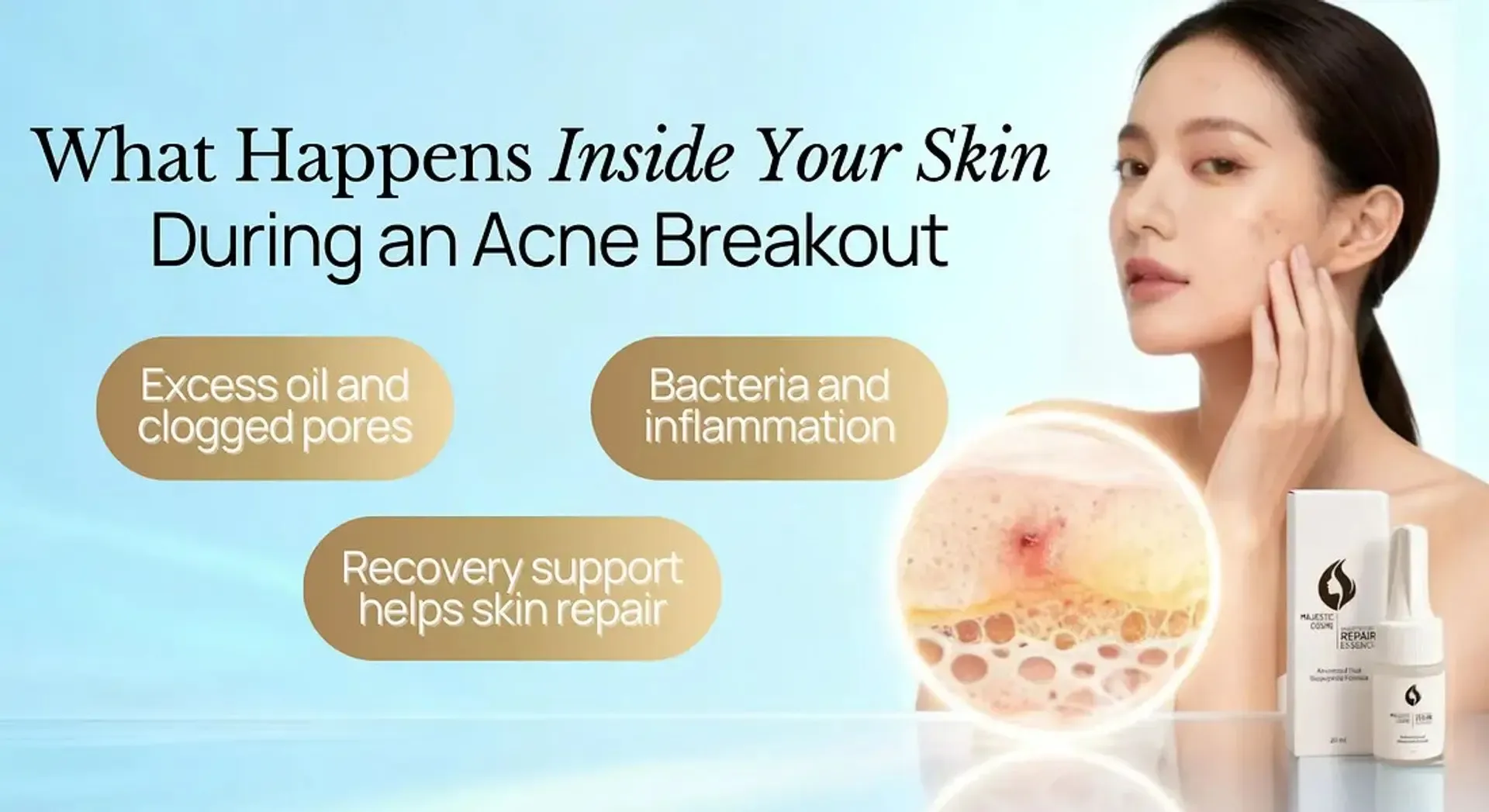
The Biology of Acne: Understanding the Four Cellular Stages of Follicular Damage
Most people treat acne as a surface problem. A pimple appears, a spot treatment is applied, and the focus stays entirely on what is visible. But what is actually happening beneath the skin during a breakout is far more complex, and far more consequential, than what appears on the surface.
Acne is a multi-stage biological event. It begins with hormonal or environmental triggers, progresses through a cascade of cellular dysfunction, and often ends by leaving structural damage in the dermis that no ordinary cleanser or spot treatment can reach. Understanding this process is the first step toward treating acne in a way that actually works at the source.
This is where regenerative skincare becomes relevant. Formulations that go beyond surface-level intervention, such as Majestic Active Repair Essence, are built specifically to interrupt the acne cycle at each of its four critical stages and support genuine tissue recovery afterward. As a 100% Nano-Solution made in Japan, it delivers its four active ingredients deep into the pore where the damage actually originates.
Most people treat acne as a surface problem. A pimple appears, a spot treatment is applied, and the focus stays entirely on what is visible. But what is actually happening beneath the skin during a breakout is far more complex, and far more consequential, than what appears on the surface.
Acne is a multi-stage biological event. It begins with hormonal or environmental triggers, progresses through a cascade of cellular dysfunction, and often ends by leaving structural damage in the dermis that no ordinary cleanser or spot treatment can reach. Understanding this process is the first step toward treating acne in a way that actually works at the source.
This is where regenerative skincare becomes relevant. Formulations that go beyond surface-level intervention, such as Majestic Active Repair Essence, are built specifically to interrupt the acne cycle at each of its four critical stages and support genuine tissue recovery afterward. As a 100% Nano-Solution made in Japan, it delivers its four active ingredients deep into the pore where the damage actually originates.
The Biology of a Breakout: Four Stages Inside the Pore
A breakout does not happen overnight. It is the end result of a sequence of events that can begin days or even weeks before a pimple becomes visible. Understanding each stage clarifies why a single-ingredient approach rarely resolves acne fully.
Stage 1: Excess Sebum Production
The sebaceous glands, which sit alongside each hair follicle, produce sebum to keep the skin lubricated. When hormonal signals, stress, or environmental factors overstimulate these glands, sebum production rises beyond what the pore can naturally clear. This excess oil accumulates inside the follicle, creating the initial conditions for a blockage.
Stage 2: Pore Blockage
As excess sebum builds up, it mixes with dead skin cells that have not shed properly. The skin's natural desquamation process, the regular shedding of the outermost layer, becomes disrupted. Keratin hardens around the follicle opening, trapping the sebum-cell mixture inside. This forms a comedone, the structural foundation of every acne lesion, whether it eventually becomes a blackhead, whitehead, or inflammatory pimple.
Stage 3: Bacterial Colonization
The trapped, oxygen-depleted environment inside a blocked pore is an ideal habitat for Cutibacterium acnes (formerly known as Propionibacterium acnes), the primary bacterium associated with inflammatory acne. This bacterium metabolizes the trapped sebum and releases fatty acids and enzymes that trigger an immune response in the surrounding tissue.
Stage 4: Inflammation and Tissue Damage
The immune system responds by sending white blood cells to the site, producing the redness, swelling, and tenderness characteristic of an active pimple. If this inflammatory response is intense or prolonged, it can rupture the follicle wall entirely, spilling bacteria and debris into the deeper dermis. This is the point at which permanent damage becomes a real risk, including post-inflammatory hyperpigmentation and atrophic scarring, the type that leaves lasting indentations in the skin.
Acne is not a skin condition that begins at the surface. It is a failure of multiple systems happening simultaneously inside the pore, and recovery requires addressing all of them.
Why Acne Leaves Damage Behind
When the follicle wall ruptures during a severe breakout, the body initiates a wound-healing response. Fibroblasts are recruited to repair the damaged tissue, and collagen is synthesized to fill the injury site. However, this repair process is imprecise. The new collagen is often deposited unevenly, resulting in either raised scarring or, more commonly in acne, atrophic scars where tissue volume is lost.
Post-inflammatory hyperpigmentation occurs separately. When the skin is inflamed, melanocytes in the basal layer are stimulated to produce excess melanin as a protective response. This melanin deposits unevenly in the healing tissue, leaving flat brown or red marks that can persist for months without targeted intervention.
This is why acne recovery is a two-part problem. The first is resolving the active lesion. The second, and often more challenging, is repairing the tissue damage that the inflammatory event leaves behind. Most over-the-counter treatments address only the first part.
Among the most clinically relevant approaches to post-acne tissue repair is the use of growth factors and copper peptides, both of which play established roles in wound healing, collagen remodeling, and pigmentation regulation.
Common Treatments vs. Regenerative Repair: A Comparison
The majority of acne treatments available today are designed to manage one stage of the breakout cycle. This single-mechanism approach explains why many people cycle through multiple products without resolving their skin concerns entirely. The table below compares how common treatment actives perform against a full-cycle regenerative approach.
| Treatment Type | What It Targets | What It Misses | Regenerative Advantage |
|---|---|---|---|
| Benzoyl Peroxide | Kills acne bacteria, reduces active lesions | No effect on sebum, pore blockage, or scar repair | Hairen eliminates bacteria while also controlling sebum at the source |
| Salicylic Acid (BHA) | Exfoliates inside pores, reduces congestion | Can strip the barrier; no tissue repair or anti-inflammatory benefit | Acnobet fuses salicylic acid with peptides to open pores without barrier disruption |
| Retinol | Accelerates cell turnover, reduces post-acne marks | Causes irritation, dryness, and peeling, especially early in use | EGF drives cell renewal and tissue healing without sensitizing the skin |
| Standard Peptide Serums | Collagen stimulation, skin firmness | Typically cannot penetrate the pore depth where acne damage occurs | GHK-Cu via nano-delivery reaches the dermis to repair indentations and restore texture |
The distinction that sets advanced skincare apart from conventional acne management is not ingredient novelty but delivery depth and multi-mechanism action. Treating one stage of the acne cycle while leaving the others unaddressed is why breakouts recur.
How Majestic Active Repair Essence Addresses the Full Cycle
Majestic Active Repair Essence was formulated around the understanding that acne is a four-stage problem, and that recovery requires intervening at every stage simultaneously. Its Dual Biopeptide Complex features two world-first biopeptides, Acnobet (Salicyloyl Octapeptide-9) and Hairen (Azelaoyl Tripeptide-1), supported by EGF (Human Oligopeptide-1) and GHK-Cu Copper Peptide Complex.
Together, these four actives address each stage of the breakout cycle:
- Acnobet softens hardened keratin blocking the pore and provides antibacterial and anti-allergy protection at the follicle level
- Hairen suppresses excess sebum production at the sebaceous gland and reduces Cutibacterium acnes activity while preventing post-inflammatory pigmentation
- EGF, the Nobel Prize-winning growth factor, accelerates the renewal of damaged skin cells and speeds recovery of inflamed tissue
- Copper Peptide (GHK-Cu) stimulates collagen and elastin synthesis in the dermis to repair the structural indentations and pockmarks left by severe lesions
All four actives are processed into nano-sized particles through the 100% Nano-Solution technology, allowing them to penetrate beyond the stratum corneum and reach the deeper layers where acne damage originates. This delivery precision is a hallmark of the best skincare from japan, where formulation science prioritizes biological efficacy over cosmetic appearance.
Clinical results confirm the formula's impact: acne-affected area reduced to less than 30% of its original size within 20 days, a 40% reduction in total pimple count after 30 days, and an approximately 83% reduction in acne bacteria with continued use. For those seeking broader cellular support alongside targeted repair, human stem cell-based formulations can complement this approach by further amplifying the skin's regenerative capacity at the cellular level.
The product is entirely free from fragrance, color additives, alcohol, and parabens, making it suitable for all skin types including sensitive and adult acne-prone skin.
How to Use Majestic Active Repair Essence for Maximum Results
Because the formula is a 100% Nano-Solution, correct application is essential to achieving full penetration depth. The nano-particles require direct contact with clean, bare skin to function at capacity.
- Cleanse thoroughly morning and night using a gentle, non-stripping cleanser. Pat dry completely before applying the essence.
- Apply the essence as the first product in your routine, before any toner, lotion, or moisturizer. Any prior layer will reduce nano-penetration efficiency.
- Dispense a small amount and press gently into the skin across the forehead, cheeks, chin, and jawline. Do not rub.
- Allow 30 to 60 seconds for absorption, then continue with the rest of your routine including moisturizer and SPF in the morning.
- Use consistently twice daily. Do not skip evening application when cellular repair is most active.
Visible reductions in active acne are typically observed within 20 days. For post-acne scar fading and texture improvement, the full collagen synthesis cycle driven by EGF and Copper Peptide requires 60 to 90 days of consistent use. The complete formulation details and clinical methodology behind these results are documented for those who want to understand the science in greater depth.
Conclusion
A breakout is not a single event. It is the visible result of a biological cascade that begins with excess oil, progresses through pore blockage and bacterial colonization, and often ends by leaving tissue damage that persists long after the pimple is gone. Understanding this sequence is what separates effective acne management from temporary symptom control.
Majestic Active Repair Essence was built to address this full cycle. By combining two world-first biopeptides with a Nobel Prize-winning growth factor and a clinically validated copper peptide, all delivered through a 100% Nano-Solution system, it intervenes at every stage of the breakout process and supports genuine dermal recovery. The result is not just clearer skin, but skin that becomes structurally stronger, more resilient, and less prone to future damage over time.
Address the Root of Dermal Congestion
Don't simply dry active blemishes superficially. Cleanse, clear, and structurally remodel follicle pathways via Majestic Active Repair Essence.
Discover Majestic Active Repair EssenceFrequently Asked Questions
Sources
- Zouboulis, C.C. (2004). "Acne and sebaceous gland function." Clinics in Dermatology, 22(5), 360–366.
- Pickart, L., & Margolina, A. (2018). "Regenerative and Protective Actions of the GHK-Cu Peptide in Human Skin." International Journal of Molecular Sciences, 19(7), 1987.
- Cohen, S. (1962). "Isolation of a Mouse Submaxillary Gland Protein Accelerating Incisor Eruption and Eyelid Opening in the Newborn Animal." Journal of Biological Chemistry, 237(5), 1555–1562.
- Kircik, L.H. (2011). "Evaluating the role of topical azelaic acid in the treatment of acne vulgaris and rosacea." Journal of Drugs in Dermatology, 10(s5), s5–s10.
- Benson, H.A.E. (2006). "Transdermal drug delivery: Penetration enhancement techniques." Current Drug Delivery, 3(4), 381–393.