.png%253Falt%253Dmedia%2526token%253D78c23398-5711-460d-b21c-4a7177094ae4%22%7D%2C%7B%22operation%22%3A%22resize%22%2C%22width%22%3A48%7D%2C%7B%22operation%22%3A%22output%22%2C%22format%22%3A%22webp%22%2C%22quality%22%3A75%7D%5D)
The Shift to Regenerative Skincare: How Dual Biopeptides Rebuild Skin Matrix Architecture
2026 is the year the skincare industry stops fighting aging and starts repairing it. Regenerative skincare, products engineered to restore skin function at the cellular level, has moved from research labs to bathroom shelves, and it is changing everything we thought we knew about how skin heals.
For decades, the beauty industry sold us on "anti-aging": serums that blurred the look of fine lines, creams that temporarily plumped skin with moisture, and retinols that forced cell turnover faster than skin could comfortably manage. These products addressed the surface. They did not address the cause.
What has changed in 2026 is not just the technology. It is the philosophy. Japanese biotech researchers have shifted the conversation entirely, from suppression to signaling, from covering to rebuilding. And at the center of this shift is an innovation called the dual biopeptide complex.
Introduction
2026 is the year the skincare industry stops fighting aging and starts repairing it. Regenerative skincare, products engineered to restore skin function at the cellular level, has moved from research labs to bathroom shelves, and it is changing everything we thought we knew about how skin heals.
For decades, the beauty industry sold us on "anti-aging": serums that blurred the look of fine lines, creams that temporarily plumped skin with moisture, and retinols that forced cell turnover faster than skin could comfortably manage. These products addressed the surface. They did not address the cause.
What has changed in 2026 is not just the technology. It is the philosophy. Japanese biotech researchers have shifted the conversation entirely, from suppression to signaling, from covering to rebuilding. And at the center of this shift is an innovation called the dual biopeptide complex.
What Makes Skincare Truly Regenerative in 2026
The word "regenerative" gets used loosely in beauty marketing. True regenerative skincare has a specific meaning: it refers to formulas that actively stimulate the skin's own biological repair mechanisms rather than simply delivering ingredients that act on the skin from the outside.
Think of the difference this way: traditional skincare deposits ingredients onto or into the skin. Regenerative skincare sends biological signals that prompt the skin to produce, repair, and renew on its own.
This requires a new class of active ingredients. In 2026, the most advanced of these are signal peptides, specifically engineered amino acid sequences that bind to receptors on skin cells and trigger specific biological responses: collagen synthesis, barrier repair, reduced inflammatory signaling, and the activation of dermal fibroblasts, the cells responsible for structural repair.
Genuinely regenerative formulas also work at a depth and precision that older actives cannot match. They are designed to survive skin contact, penetrate to the target cell layer, and communicate a specific instruction. This is not serendipitous chemistry. It is deliberate biotech.
The Science Behind Regenerative Skincare: Dual Biopeptide Innovation
Peptides have existed in skincare for years, but most commercial formulas use single-peptide systems that target one pathway at a time. The breakthrough driving the regenerative skincare movement in 2026 is the dual biopeptide complex: two complementary peptides engineered to work in concert, addressing skin aging from two angles simultaneously.
How a Dual Biopeptide Complex Works
The first peptide in a dual system typically activates collagen type I and III synthesis in the dermis. These are the structural proteins that give skin its firmness, elasticity, and density. As the body ages, synthesis rates decline and degradation accelerates. A well-designed signal peptide can slow this decline and partially reverse the deficit.
The second peptide targets a different pathway, often the inhibition of matrix metalloproteinases (MMPs), the enzymes that break down existing collagen and elastin. By pairing a synthesis activator with a degradation inhibitor, the dual system creates a more favorable net result than either peptide could achieve alone.
Japanese biotech laboratories have been particularly rigorous in the design of these peptide pairs. The focus is on bioavailability (how much of the peptide reaches the target cell), receptor specificity (how precisely it binds), and synergistic dosing (the ratio at which two peptides enhance each other's activity). This level of precision is why Japanese formulations have led clinical benchmarking in this category. For a deeper look at clinical-level applications of these technologies, see our guide on Clinical-Level Skin Treatment.
Japanese vs. Western Approaches to Skin Regeneration
Both Japanese and Western brands are investing in peptide technology, but the philosophies behind their formulation approaches differ in ways that matter for the consumer.
| Dimension | Japanese Biotech Approach | Conventional Western Approach |
|---|---|---|
| Primary mechanism | Biological signaling; prompts skin to self-repair | Forced cell turnover or surface-level delivery |
| Core actives | Engineered signal peptides; fermented bioactives | Retinoids, AHAs, vitamin C derivatives |
| Skin tolerance | High; designed to work with the skin barrier | Variable; irritation is common at effective doses |
| Formulation philosophy | Precision dosing; synergistic ingredient pairs | High-concentration single actives |
| Result timeline | Gradual, structural improvement over weeks | Faster surface change; slower structural benefit |
| Long-term skin health | Improves barrier function and cellular resilience | Risk of barrier disruption with prolonged use |
The Japanese approach does not produce overnight miracles. What it produces is a measurable improvement in the quality and function of skin over time. This results in skin that behaves younger because it is functionally closer to younger skin, not because a product is sitting on its surface creating an illusion. To learn more about the science culture behind Majestic Cosme formulations, visit our Japanese biotech innovation story.
Why Regenerative Skincare Is Replacing Traditional Anti-Aging
Consumer behavior data from 2025 and early 2026 shows a clear pattern: the fastest-growing segment of the prestige skincare market is not retinol, not vitamin C, and not exfoliants. It is peptide-based repair formulas.
Three factors are driving the shift:
- Frustration with sensitization. Years of high-dose retinoid and acid use has left a significant portion of consumers with compromised barriers. They are looking for results without the friction.
- Growing science literacy. Consumers in the 30-55 age range increasingly understand the difference between surface-level improvement and cellular-level repair.
- Visible, measurable results. Clinical studies on dual biopeptide complexes are showing wrinkle depth reductions and measurable increases in dermal density.
Clinical Results: Before vs. After Regenerative Treatment
Independent clinical assessments of dual biopeptide formulations have produced consistent findings. Below is a summary of the types of outcomes documented:
| Skin Concern | Measurement Method | Observed Outcome (12 Weeks) |
|---|---|---|
| Fine lines and wrinkles | 3D profilometry | Up to 30% reduction in wrinkle volume |
| Firmness and elasticity | Cutometer assessment | Significant improvement in elastic recovery |
| Barrier integrity | TEWL measurement | Reduced TEWL; improved moisture retention |
| Luminosity and tone | Spectrophotometry | Increased radiance scores; even pigmentation |
| Collagen density | High-frequency ultrasound | Measurable increase in dermal echo density |
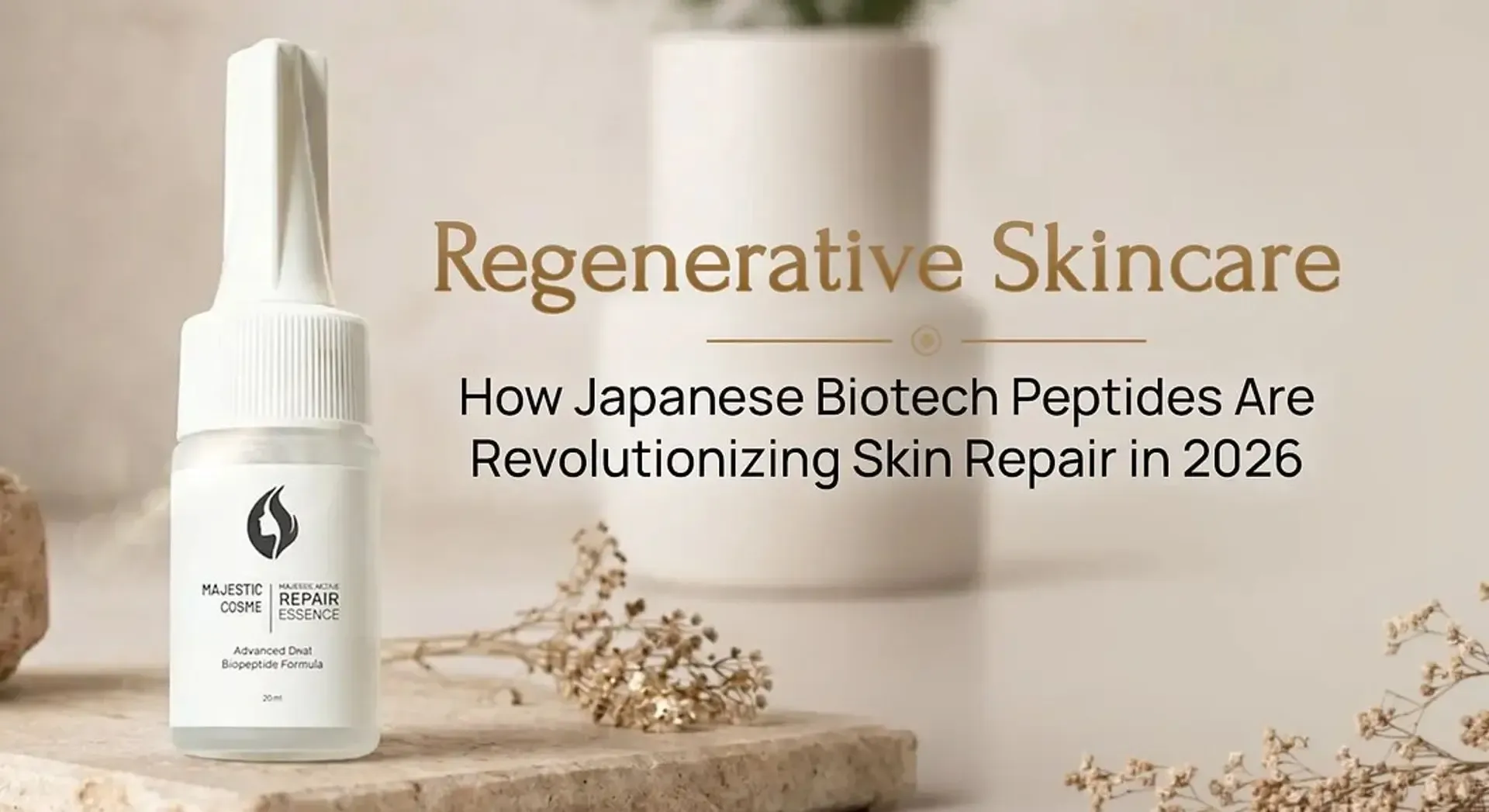
The Majestic Active Repair Essence Dual Peptides were developed using this biotech framework. They are engineered for synergistic action, clinically benchmarked, and formulated for daily use without barrier compromise.
Building Your Regenerative Skincare Routine
A Simple Framework:
- Gentle cleanser: Remove residue without stripping the acid mantle.
- Hydrating toner or mist: Prepare the skin; a damp surface helps peptides penetrate.
- Dual biopeptide essence: Apply the core active here. Pat gently rather than rubbing.
- Barrier-supporting moisturizer: Seal the skin and support the overnight repair cycle.
- Morning SPF: Peptide-repaired skin is responsive; protect it from UV-induced MMP activation.
Majestic Active Repair Essence
Developed with a high-performance dual biopeptide complex in our Japanese laboratory. This essence is engineered for those who want real biological repair and visible skin health without the professional price tag.
Shop Majestic Active Repair Essence NowFrequently Asked Questions
Sources
- Schagen, S. K. (2017). "Topical Peptide Treatments with Effective Anti-Aging Results." Cosmetics.
- Lupo, M. P., & Cole, A. L. (2007). "Cosmeceutical peptides." Dermatologic Therapy.
- Baumann, L. (2018). "How to use the Cosmeceutical Approach in Anti-Aging Medicine." Clinics in Dermatology.
- Gorouhi, F., & Maibach, H. I. (2009). "Role of topical peptides in preventing aged skin." International Journal of Cosmetic Science.
- Errante, F., et al. (2020). "Cosmeceutical Peptides in the Framework of Sustainable Wellness Economy." Frontiers in Chemistry.