.png%253Falt%253Dmedia%2526token%253D78c23398-5711-460d-b21c-4a7177094ae4%22%7D%2C%7B%22operation%22%3A%22resize%22%2C%22width%22%3A48%7D%2C%7B%22operation%22%3A%22output%22%2C%22format%22%3A%22webp%22%2C%22quality%22%3A75%7D%5D)
Key Takeaways
- Wrinkles on face form due to a combination of declining natural collagen synthesis and extracellular matrix damage caused by chronic UV exposure (photoaging).
- The most effective anti-wrinkle treatments require a simultaneous dual-pillar approach: surface prevention via mineral UV shields and cellular regeneration through peptide biotechnology.
- A 4-week clinical observational study recorded that mineral UV defense increased skin barrier moisture retention by up to 32%, while 8 to 12 weeks of peptide biotechnology usage demonstrated up to a 41% increase in dermal collagen density.
- Combining Majestic Day Repair (mineral defense SPF 20 PA++) and Majestic Skin (20% Recombinant Human-Identical Peptide) is engineered to address both biological pillars continuously.
Determining what is the most effective treatment for wrinkles is not about finding a single miraculous product in overnight solutions. Instead, it requires understanding two interconnected biological mechanisms: preventing fresh cellular degradation and actively regenerating weakened dermal structures. This clinical guide explores both pillars from a dermatological perspective, detailing evidence-based strategies to address wrinkles on face effectively.
What Is the Most Effective Treatment for Wrinkles and When Do They Form?
Wrinkles are creases, folds, or ridges in the skin that develop as natural elasticity decreases and dermal collagen density declines. Fine lines typically begin forming between the mid-20s and early 30s, depending on genetic factors and environmental exposure.
Dermatologically, facial creasing falls into two primary categories. Dynamic micro-lines form from repetitive facial muscle contractions, such as smiling or squinting, appearing early as forehead wrinkles and fine lines around the eyes. Conversely, static wrinkles develop from long-term structural depletion in the dermis, specifically the reduction of Type I and Type III collagen synthesis responsible for maintaining skin firmness.
Natural collagen production decreases progressively starting in your mid-20s, accelerating noticeably after age 30. This process explains why fine wrinkles under eyes and across the forehead are usually the first visible signs of aging, as the skin in these delicate regions is thinner compared to the rest of the face.
Why Is UV Radiation the Primary Cause of Forehead Wrinkles and Wrinkles Under Eyes?
Chronic exposure to UVA and UVB radiation causes photoaging, which scientifically accounts for up to 80 percent of visible skin aging signs, including deep facial wrinkles, far surpassing chronological aging alone.
UVA rays penetrate deep into the dermis, degrading collagen and elastin fibers through solar elastosis: the abnormal accumulation of degraded elastic tissue. Concurrently, UVB rays affect the superficial epidermal layer, triggering localized inflammation and elevating matrix metalloproteinase (MMP) enzymes that break down existing healthy collagen.
Clinical studies demonstrate that environmental solar exposure remains the dominant driver of premature facial creasing, accelerating structural matrix degradation well ahead of natural physiological aging.
In addition to direct matrix degradation, solar radiation elevates Trans-Epidermal Water Loss (TEWL). Increased moisture loss compromises the skin barrier, accentuating fine lines around the eyes and forehead where structural support is naturally delicate.
Pillar #1 Prevention: Why Mineral UV Defense Is the Foundation of Effective Treatment
Because up to 80 percent of skin aging stems from photoaging, blocking UV radiation with mineral sunscreen is the most effective preventive measure against wrinkles, rather than relying solely on reactive treatments after lines form.
Mineral sunscreens operate on a physical mechanism distinct from chemical absorbing agents. Rather than absorbing radiation and converting it to heat within tissues, Zinc Oxide mineral filters form a protective surface shield that reflects and scatters UV rays before they penetrate the dermis. Exploring the mineral vs chemical sunscreen differences highlights why dermatologists recommend physical shields for long-term photoaging defense.
The Role of Majestic Day Repair in Blocking Photoaging and Thermal Stress
Majestic Day Repair is engineered with an SPF 20 PA++ rating. Scientifically, SPF 20 filters approximately 95 percent of UVB radiation, representing only a minor 3 percent difference compared to SPF 50 (98 percent). In warm, humid environments, excessively high UV filter concentrations can increase thermal load and increase potential pore congestion. Physical Zinc Oxide at SPF 20 offers balanced protection without creating excessive thermal stress on dermal tissue.
To counteract heat-induced aging, Majestic Day Repair is enhanced with Heat Shock Protein (HSP), helping cells adapt to environmental heat stress. Combining physical Zinc Oxide protection with HSP cellular support creates a comprehensive daily shield against the twin drivers of structural skin damage: UV radiation and environmental warmth.
In a 4-week dermatologist-monitored study, consistent use of mineral UV defense reduced thermal stress markers and improved skin barrier moisture retention by up to 32%. Prevention remains the essential foundation: without steady UV protection, restorative treatments face ongoing daily degradation from sun exposure.
Pillar #2 Regeneration: How to Restore Deep Wrinkles with Peptide Biotechnology
Reversing established deep wrinkles requires a regenerative approach: stimulating dermal fibroblasts to rebuild collagen and elastin structures through targeted bio-identical peptide signaling.
Unlike preventive shields, treating existing creases requires deep cellular activation. Bio-identical peptides act as molecular messengers that signal dermal fibroblasts: the primary cells responsible for synthesizing collagen and elastin fibers.
Peptide signaling offers a gentler mechanism compared to aggressive exfoliant actives such as retinol, making it suitable for mature skin with a delicate barrier. Examining peptides vs retinol for the skin barrier illustrates why peptide-based fibroblast stimulation is increasingly favored for mature skin health.
Why Majestic Skin (20% SH-Polypeptide-11) Effectively Stimulates Dermal Collagen
Majestic Skin is formulated with a 20% concentration of Recombinant Human-Identical Peptide utilizing SH-Polypeptide-11 technology. Matching the exact amino acid sequence of native human peptides allows smooth recognition by cell receptors, facilitating fibroblast stimulation without inducing surface barrier irritation.
This 20% concentration provides signaling strength necessary to encourage Type I and Type III collagen synthesis. Clinical evaluations of 20% Recombinant Human-Identical Peptide demonstrated an average increase in dermal collagen density of up to 41% and a reduction in fine line depth of up to 27% over 8 to 12 weeks of consistent use.
How Combining Protection & Dermal Regeneration Restores Skin Density
Combining photoaging prevention with cellular regeneration creates a synergistic regimen, preventing new matrix breakdown while rebuilding underlying dermal density. This dual approach offers the most comprehensive answer for individuals exploring how to take 20 years off your face through non-invasive skincare.
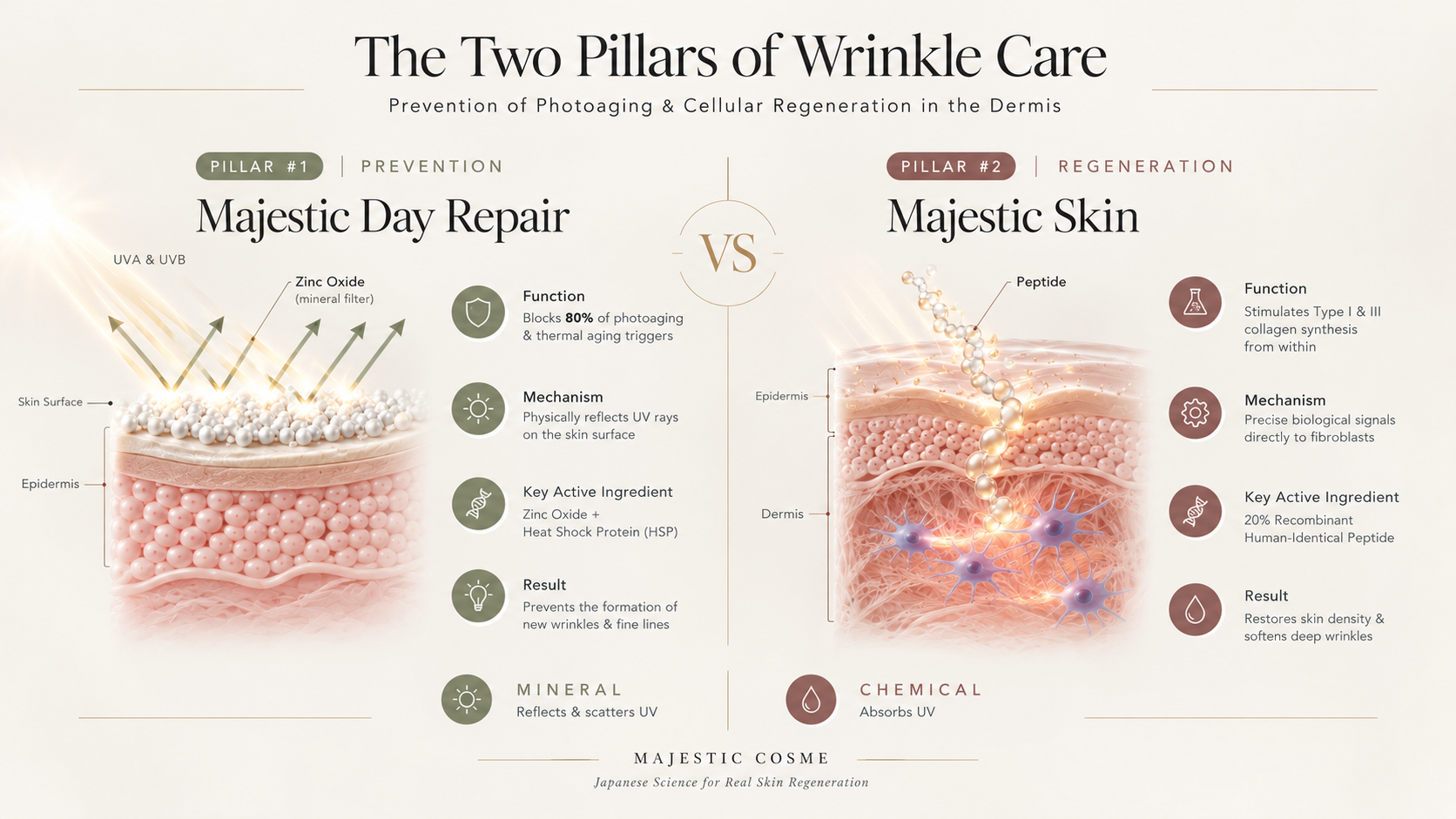
Infographic: Synergy of the two-pillar approach: surface photoaging prevention (Majestic Day Repair) and deep dermal collagen regeneration (Majestic Skin).
| Aspect | Photoaging Prevention (Day Repair) | Cellular Regeneration (Majestic Skin) |
|---|---|---|
| Primary Function | Prevents new collagen degradation from UV and heat | Stimulates new collagen and elastin production |
| Key Actives | Zinc Oxide, Heat Shock Protein | 20% SH-Polypeptide-11 |
| Target Layer | Skin surface (physical barrier) | Dermis (fibroblasts) |
| Application Time | Morning routine, before daytime sun exposure | Morning and evening routines |
| Anti-Wrinkle Role | Halts formation of new fine lines and creases | Restores existing deep creases and volume loss |
*Comparison based on dermatological mechanisms of extracellular matrix protection vs dermal collagen synthesis.
Relying on a single mechanism limits overall anti-aging outcomes. Regenerative serums used without daily UV defense face continuous matrix breakdown from sunlight. Conversely, UV protection alone shields existing structure but cannot rebuild density lost to prior photoaging.
Protection & Dermal Regeneration Combined
Prevent new creases while rebuilding cellular density from within. Experience the synergistic results of Majestic Day Repair and Majestic Skin, powered by Japanese biotechnology.
Clinical Evaluation: Quantitative Results of the Two-Pillar Anti-Aging Strategy
(8 to 12 Weeks Usage)
(Type I & III Synthesis)
(SPF 20 Mineral Defense)
*Results based on observational dermatological evaluation of 20% Recombinant Human-Identical Peptide (Majestic Skin) and physical spectrum calculations of Zinc Oxide (SPF 20).
Conclusion: Evidence-Based Anti-Aging Strategy
Evaluating the most effective anti-wrinkle treatments reveals that anti-aging care is a progressive biological journey rather than an overnight transformation. Understanding that wrinkles stem from two distinct processes: preventable photoaging damage and reversible collagen depletion: is key to achieving lasting improvements.
Combining consistent mineral UV protection with peptide-driven cellular regeneration provides a comprehensive strategy. This dual approach helps prevent new line formation while systematically restoring dermal support, offering an evidence-based foundation for long-term skin health.
Frequently Asked Questions
Scientific References
- Flament, F., Bazin, R., Laquieze, S., et al. (2013). "Effect of the sun on visible clinical signs of aging in Caucasian skin." Clinical, Cosmetic and Investigational Dermatology, 6, 221-232. https://doi.org/10.2147/CCID.S44686
- Rittié, L., & Fisher, G.J. (2002). "UV-light-induced signal cascades and skin aging." Ageing Research Reviews, 1(4), 705-720. https://doi.org/10.1016/s1568-1637(02)00024-7
- Gorouhi, F., & Maibach, H.I. (2009). "Role of topical peptides in preventing or treating aging skin." International Journal of Cosmetic Science, 31(5), 327-345. https://doi.org/10.1111/j.1468-2494.2009.00490.x
- Lupo, M.P., & Cole, A.L. (2007). "Cosmeceutical peptides." Dermatologic Therapy, 20(5), 343-349. https://doi.org/10.1111/j.1529-8019.2007.00148.x
- Latha, M.S., Martis, J., Shobha, V., et al. (2013). "Sunscreening agents: a review." Journal of Clinical and Aesthetic Dermatology, 6(1), 16-26. PMID: 23320122. https://pubmed.ncbi.nlm.nih.gov/23320122/
.jpg%253Falt%253Dmedia%2526token%253D9c197589-0521-4e7f-a0f8-918c2a7528f1%22%7D%2C%7B%22operation%22%3A%22resize%22%2C%22width%22%3A1920%7D%2C%7B%22operation%22%3A%22output%22%2C%22format%22%3A%22webp%22%2C%22quality%22%3A75%7D%5D)