.png%253Falt%253Dmedia%2526token%253D78c23398-5711-460d-b21c-4a7177094ae4%22%7D%2C%7B%22operation%22%3A%22resize%22%2C%22width%22%3A48%7D%2C%7B%22operation%22%3A%22output%22%2C%22format%22%3A%22webp%22%2C%22quality%22%3A75%7D%5D)
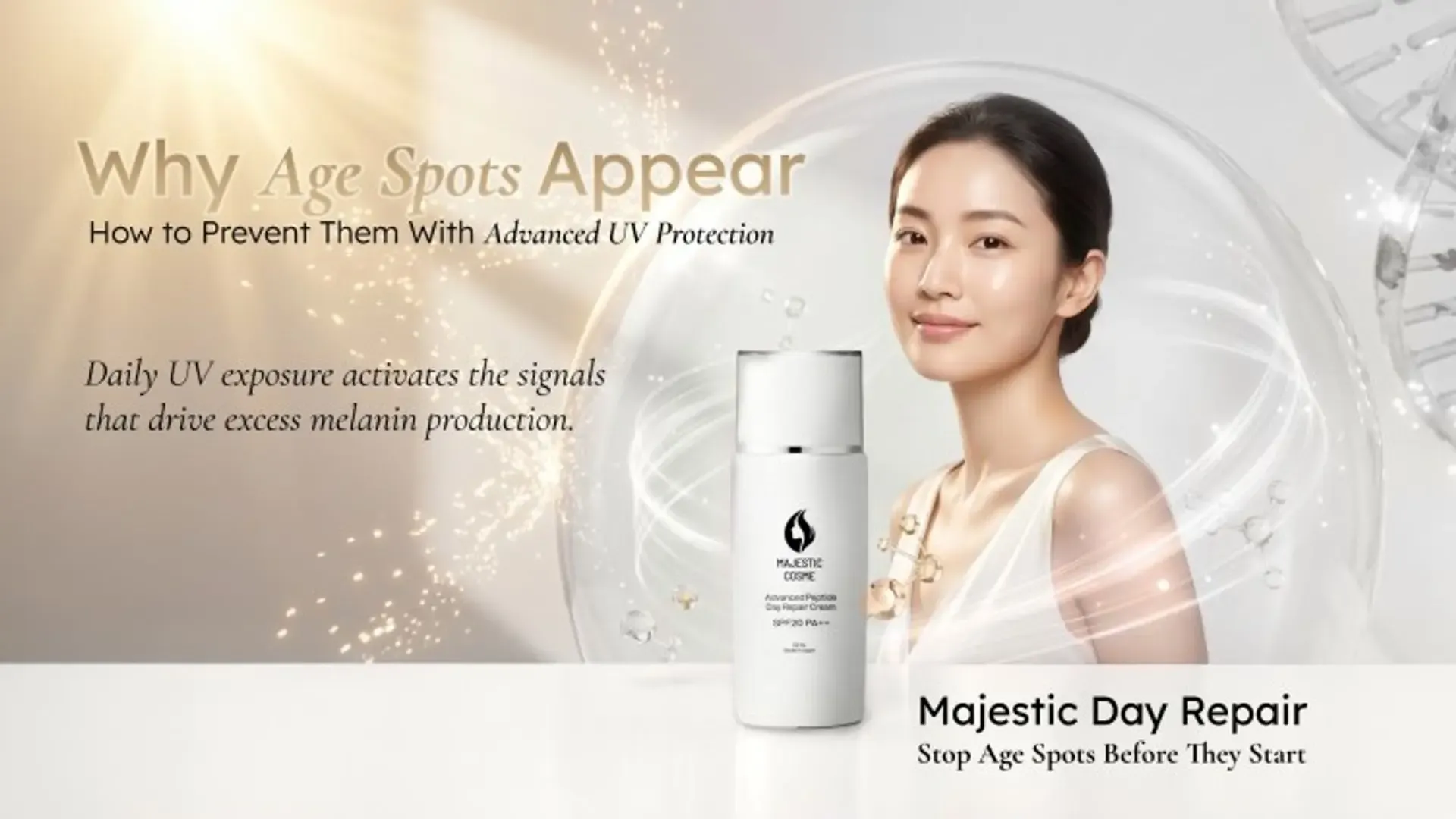
Discover Why Age Spots Form Due To Daily Sun Exposure.
Age spots form primarily because of cumulative sun exposure. When UV radiation reaches the skin, it triggers a hormonal signal that instructs pigment-producing cells to create excess melanin, which builds up over time as the flat brown patches commonly seen on the face, hands, and shoulders. While genetics and skin type play a role in how visible this process becomes, UV exposure is the trigger that starts it.
Understanding this mechanism changes how you think about prevention. Age spots are not random. They are the predictable output of a biological signaling chain that begins the moment UV light hits your skin. And once you understand that chain, you can understand exactly where it can be interrupted, both before damage occurs and after.
What Exactly Are Age Spots?
Age spots, medically known as solar lentigines, are flat, oval areas of increased pigmentation on the skin. They typically appear in shades of tan, brown, or black and develop most commonly on areas that receive the most cumulative sun exposure: the face, hands, shoulders, and forearms.
Despite the name, age spots are not a direct consequence of aging itself. They are a consequence of accumulated UV exposure over the course of a lifetime, and they become more visible with age simply because the cumulative exposure has had more time to build up. Two people of the same age can have dramatically different amounts of visible pigmentation depending on their lifetime sun exposure history and the consistency of their UV protection.
The biological process that creates age spots involves melanin, the pigment that gives skin its color. Melanin is produced by cells called melanocytes, and its production is normally a protective response: more melanin means more natural defense against UV radiation. The problem is not melanin itself. The problem is the trigger that causes melanocytes to overproduce it in concentrated, localized areas, creating the visible spots rather than an even, gradual tan.
How the Sun Commands Your Skin to Create Dark Spots
The process by which UV exposure becomes a dark spot follows a specific signaling chain, and understanding each step reveals exactly where modern skincare technology can intervene.
When UV radiation reaches skin cells, it causes direct damage to the DNA within those cells. This damage is registered by the cell as a stress signal. In response, the skin's hormonal system releases alpha-MSH (alpha-melanocyte stimulating hormone), a signaling molecule that travels to nearby melanocytes.
Alpha-MSH acts as a command. It binds to receptors on melanocytes and instructs them to ramp up melanin production. The melanocytes respond by producing and distributing melanin to surrounding skin cells. Where this process is concentrated and repeated in the same location over time, often the same areas that receive the most direct sun exposure, the result is the visible buildup we recognize as a dark spot.
This is the chain: UV exposure leads to DNA stress signals, which lead to alpha-MSH release, which lead to melanocyte activation, which leads to localized melanin overproduction, which leads to a visible age spot.
A 2013 study published in Clinical, Cosmetic and Investigational Dermatology estimated that approximately 80 percent of visible facial aging, including pigmentation changes like age spots, is attributable to UV exposure. The majority of this comes from daily incidental exposure accumulated over years, not from occasional intense sun events.
Standard sunscreen interrupts this chain at the very first step, by reducing how much UV reaches the skin. But it does nothing to interrupt any of the steps that follow. If UV gets through, even in small amounts, the alpha-MSH signal can still be triggered, melanocytes can still be activated, and the spot-forming process can still proceed.
A New Way to Prevent Age Spots: Blocking the Melanin Signal
The most direct way to prevent a new age spot from forming is to interrupt the alpha-MSH signal before it reaches melanocytes. This is the function of ASP, a functional peptide technology used in Majestic Day Repair Cream.
ASP (Aspartyl Stearate) works by intercepting the alpha-MSH command at the biochemical level, before it can bind to melanocyte receptors and trigger excess melanin production. If the signal does not arrive, the instruction to overproduce pigment is never given. No instruction means no concentrated melanin buildup, which means no new age spot forms from that UV exposure.
This is fundamentally different from how brightening ingredients work. Brightening serums, including vitamin C and niacinamide, work after melanin has already been produced and deposited, helping to fade existing pigmentation. ASP works before melanin production begins, intercepting the instruction itself.
The practical implication is straightforward: ASP technology targets prevention of new age spots, while brightening ingredients target correction of existing ones. Used together, the two approaches address both directions of the problem, but ASP is the mechanism that addresses the root cause at its source.
ASP also has a secondary effect. The same alpha-MSH signal that triggers melanin production also activates matrix metalloproteinases (MMPs), enzymes that break down collagen. By blocking alpha-MSH, ASP technology reduces both the pigmentation signal and the collagen-degradation signal simultaneously, addressing two visible signs of photoaging through a single mechanism.
For a deeper exploration of how this temporary signal-blocking technology fits into a complete triple-action approach to age spot prevention, this guide on the daytime DNA repair crew covers the full mechanism in detail.
Why Non-Chemical UV Protection Is a Gentler Choice for Your Skin
The first line of defense against age spot formation remains UV protection itself. Majestic Day Repair Cream uses a Mineral Shield of zinc oxide and titanium dioxide, two non-chemical UV reflectors with long-established safety profiles.
Unlike chemical UV filters, which absorb UV radiation and convert it to heat through a chemical reaction on the skin, zinc oxide and titanium dioxide work by physically reflecting and scattering UV rays before they penetrate the skin surface. This distinction matters for several reasons relevant to age spot prevention specifically.
Physical reflectors do not undergo photodegradation. Chemical filters, particularly avobenzone, lose a portion of their UVA-filtering capacity within hours of sun exposure unless reformulated with stabilizers or reapplied frequently. UVA is the wavelength most associated with the deep, gradual DNA damage that drives age spot formation over years. A UV shield that maintains consistent protection throughout the day addresses this wavelength more reliably.
Non-chemical UV protection is also generally considered a gentler option for sensitive skin. Zinc oxide and titanium dioxide are not absorbed into the bloodstream and are far less likely to cause the stinging or irritation that some chemical filters can trigger, particularly around the eye area. For anyone using a daily sun protection product as part of a long-term age spot prevention routine, tolerability is not a minor consideration. A product that causes irritation is a product that gets used inconsistently, and inconsistency in UV protection directly translates to more opportunities for the alpha-MSH cascade to occur.
Japanese formulation technology has addressed the historical drawback of mineral sunscreens, the chalky white cast, through advanced micronization. The Mineral Shield in Majestic Day Repair Cream applies as an invisible, smooth finish that functions as a primer base for makeup.
Integrating Age Spot Prevention Into Your Daily Routine
Preventing age spots is not a single action. It is a daily habit that compounds over months and years, which is why the product chosen for this role needs to be something that fits naturally into an existing routine without adding friction.
Majestic Day Repair Cream is designed to function as the final step of a morning skincare routine and the first step of makeup application, combining UV protection, signal blocking, and DNA repair support into one application:
- Cleanse and apply any water-based serums first, allowing them to absorb fully.
- Apply a pea-sized amount of Majestic Day Repair Cream evenly across the face, jaw, and neck using upward strokes.
- Wait 60 seconds before applying foundation or other makeup. This allows the Mineral Shield to settle and the primer surface to form.
- One morning application is sufficient for ordinary daily use. Reapply after two or more continuous hours of direct outdoor sun exposure.
- Apply every morning, regardless of weather. UV exposure that triggers the alpha-MSH cascade occurs on cloudy days and through windows, not only on visibly sunny days.
Consistency is the variable that determines results. A product used occasionally cannot meaningfully reduce the frequency of the alpha-MSH cascade. A product used every morning, regardless of whether the sun feels strong that day, addresses the cumulative exposure that drives age spot formation over years.
For those who want to understand how this daily protection also addresses environmental factors beyond UV, including pollution and blue light that can independently trigger pigmentation responses, this guide on multi-spectrum environmental defense covers the broader picture of daily skin stressors.
The Right Level of Protection for Everyday Life
A common question when evaluating daily sun protection is whether a moderate SPF is sufficient, or whether higher numbers are necessary for meaningful age spot prevention.
For ordinary daily use, including time spent indoors near windows, commuting, and incidental outdoor activity, SPF 20 applied correctly and consistently blocks approximately 95 percent of UVB radiation. The PA++ rating on Majestic Day Repair Cream confirms meaningful UVA protection as well, which is the wavelength most relevant to the gradual DNA damage that drives age spot formation.
The more important variable than the SPF number itself is consistency and photostability. A high-SPF chemical sunscreen that degrades over the course of the day and is rarely reapplied provides less real-world protection than a moderate-SPF mineral formula that maintains its protection level from morning until evening without degradation.
For extended outdoor activities involving direct, continuous sun exposure, such as a day at the beach or several hours of outdoor sport, a higher SPF with frequent reapplication remains appropriate. For the daily indoor-outdoor routine that constitutes most of the cumulative UV exposure responsible for age spots, SPF 20 PA++ applied every morning as part of a consistent routine, combined with ASP signal blocking and HSP repair support, addresses the problem at a level that SPF alone cannot.
Frequently Asked Questions
Majestic Day Repair
Discover the daily repair cream designed to stop age spots before they form. Experience what clear skin looks like when the biology is right.
Shop Majestic Day RepairSources
- Flament, F., et al. "Effect of the sun on visible clinical signs of aging in Caucasian skin." Clinical, Cosmetic and Investigational Dermatology, 2013.
- Trautinger, F. "Heat shock proteins in the photobiology of human skin." Journal of Photochemistry and Photobiology B: Biology, 2001.
- Schuch, A. P., et al. "DNA damage as a biological sensor of UV exposure." Photochemical and Photobiological Sciences, 2017.
- Stege, H., et al. "Enzyme plus sunscreen versus either sunscreen or enzyme alone for the UV-induced DNA damage in skin." Journal of Investigative Dermatology, 2000.
- Menter, J. M., et al. "Recent developments in sunscreen regulations and the implications for human health." Photodermatology, Photoimmunology and Photomedicine, 2020.