.png?alt=media&token=78c23398-5711-460d-b21c-4a7177094ae4)
"How to Identify" Stem Cell Scams Article: The Complete Diagnostic Guide
Key Takeaways
- Check the Ingredient: Genuine serums list 'Human Adipose-Derived Stem Cell Conditioned Media' (ADSC-CM), not plant extracts.
- Verify the Technology: Effective formulas require a delivery system like liposome technology to work. No mention is a red flag.
- Demand Transparency: Vague terms like 'stem cell complex' or hidden concentrations are signs of a low-quality product.
Clinical Guide
- Why the Market Is Flooded with Misleading "Stem Cell" Products
- Red Flag 1: The "Plant Stem Cell" Deception
- Red Flag 2: Vague Ingredient Lists and Hidden Concentrations
- Red Flag 3: No Mention of Advanced Delivery Systems
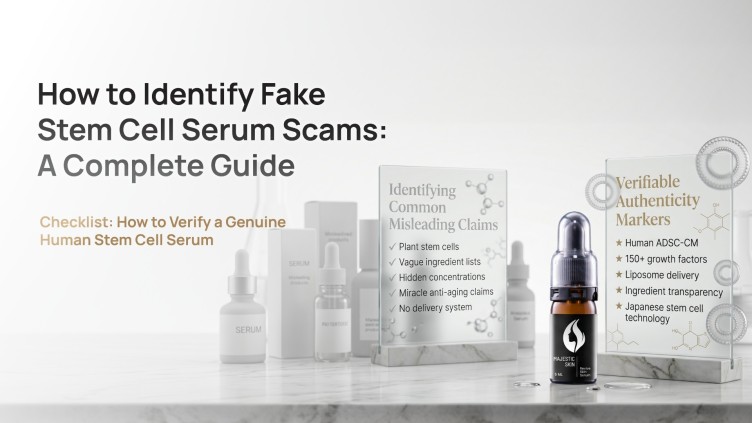
- Checklist: How to Verify a Genuine Human Stem Cell Serum
- The Majestic Skin Standard: Authenticity in Every Drop
- Frequently Asked Questions
- Scientific References
Direct answer: This definitive how to identify stem cell scams article clarifies that most products marketed as a stem cell face serum contain no real cellular components. Consumers searching for a premium human stem cell serum often encounter products leveraging plant stem cells vs human bio-activity. A true anti-aging formula relies on genuine Japanese stem cell technology containing adipose-derived stem cell conditioned media (ADSC-CM). To evaluate performance, you must insist on total ingredient transparency, a verified presence of active growth factors, and a proven micro-encapsulation liposome technology to pass the epidermal barrier. This breakdown provides the precise scientific criteria to detect misleading industry claims immediately.
Quick Scam Checklist: Know Before You Buy
- RED FLAG Product says "stem cell" but lists only plant extracts (apple, rose, edelweiss, grape)
- RED FLAG No percentage or concentration disclosed for the stem cell ingredient
- RED FLAG No mention of how growth factors penetrate the skin barrier
- RED FLAG Manufactured with heat (standard cosmetic process denatures growth factor proteins)
- RED FLAG No regulatory registration or third-party purity testing disclosed
- RED FLAG INCI list shows "Human Stem Cell Conditioned Media" without a named cell source or origin country
Why the Market Is Flooded with Misleading "Stem Cell" Products
The term "stem cell" is not regulated in cosmetics. Any brand can print it on a label without using any ingredient derived from human stem cells. Regulatory bodies such as the FDA classify topical products as cosmetics if they do not claim to change biological structure, meaning the ingredient claims on the label face far less scrutiny than the safety claims.
This regulatory gap created a market opportunity. As human stem cell conditioned media began generating genuine clinical results in peer-reviewed research, brands moved quickly to attach the vocabulary to products that shared nothing except the name. The result is a category where the majority of products are either entirely plant-based, or contain human-derived ingredients at concentrations too low to produce biological activity, or cannot deliver their actives past the skin surface.
Understanding the three most common failure modes in this category is the fastest way to protect your investment and make an informed decision.
Red Flag 1: The "Plant Stem Cell" Deception
What it looks like
The product label prominently displays "Stem Cell Serum" or "Stem Cell Technology." The INCI list contains entries like Malus Domestica Fruit Cell Culture Extract (apple), Argania Spinosa Callus Culture Filtrate (argan), Rosa Damascena Callus Culture Extract (rose), or Leontopodium Alpinum Meristem Cell Culture (edelweiss). Human cells are absent from the formulation entirely.
Plant stem cell extracts are real ingredients with genuine skincare benefits. They contain antioxidant polyphenols and phytochemicals that protect the skin surface from oxidative stress. This is legitimate and valuable. The deception is not in the ingredient itself. It is in marketing it as equivalent to human stem cell technology.
Human growth factors, the molecular signals that coordinate collagen synthesis and tissue repair, are species-specific. They bind to receptor proteins on human cell surfaces because they evolved to do exactly that. The receptor system is a biological lock-and-key: the right molecular shape opens the right receptor and initiates the right cellular response.
A growth factor produced by an apple callus cell does not match the key shape required to open human fibroblast receptors. It cannot instruct human fibroblasts to increase collagen production because the molecular signal and the receptor were not designed to interact. Plant stem cell extracts provide antioxidant surface benefit. They do not produce fibroblast activation, collagen synthesis stimulation, or structural anti-aging results at the dermal level.
The complete scientific explanation of what genuine human stem cell conditioned media actually contains, and why the source matters biologically, is covered in the detailed guide on what a human stem cell serum actually is.
| Ingredient Type | Fibroblast Receptor Activity | Collagen Synthesis |
|---|---|---|
| Human ADSC-CM (genuine) | Direct receptor binding | Stimulated via FGF, TGF-beta |
| Plant stem cell extract | No human receptor compatibility | None at dermal level |
| Synthetic peptide (single) | Limited, single-pathway only | Mild, one mechanism |
| ADSC-CM listed but concentration hidden | Cannot be verified | Likely sub-therapeutic |
Red Flag 2: Vague Ingredient Lists and Hidden Concentrations
What it looks like
The product lists "Human Adipocyte Conditioned Media Extract" or similar on the INCI. But there is no percentage disclosed. The brand describes its formula as a "proprietary blend." The ADSC-CM appears deep in the ingredient list, which in INCI convention signals a low concentration, typically below 1%.
Concentration is the variable that determines whether a growth factor product produces measurable biological activity or expensive surface hydration. The clinical evidence for structural anti-aging outcomes with topical ADSC-CM is concentrated at 15% and above. Below 5%, the growth factor signal delivered to fibroblasts is insufficient to produce measurable collagen density change in published studies.
A product that lists ADSC-CM without disclosing concentration is not providing the information you need to evaluate whether its active ingredient can perform the biological function being claimed. Reputable brands that use ADSC-CM at therapeutic concentration disclose that concentration prominently, because it is their primary clinical differentiator. The absence of this disclosure is informative in itself.
Look for: explicit percentage statements (such as "20% ADSC-CM"), third-party verified concentration, and the ADSC-CM entry appearing early in the INCI list (ingredients are listed in descending order of concentration).
Red Flag 3: No Mention of Advanced Delivery Systems
What it looks like
The product claims to contain genuine human growth factors but makes no mention of how those growth factors penetrate the skin barrier. No liposome technology. No encapsulation system. No delivery mechanism of any kind described. The formula is marketed purely on the basis of its ingredient list.
Growth factor proteins range from 6,000 to over 25,000 daltons in molecular weight. The skin barrier's general permeability threshold for passive diffusion is approximately 500 daltons. Without a dedicated delivery mechanism, growth factors remain at the skin's surface regardless of their concentration or biological activity. They cannot reach the dermal fibroblasts where collagen synthesis occurs.
This is the second most common way an otherwise-legitimate ingredient formulation fails in practice. A product can contain genuine, biologically active ADSC-CM at meaningful concentration and still produce no structural anti-aging benefit if the growth factors cannot penetrate the stratum corneum to reach their cellular targets.
Liposome Technology solves this problem by encapsulating growth factors in phospholipid vesicles that are structurally compatible with the cell membrane bilayer. These vesicles penetrate the skin barrier through intercellular lipid pathways that are closed to free molecules above 500 daltons, carrying their growth factor payload to the dermis where fibroblasts are located.
Cold Process manufacturing is the complementary requirement. Growth factor proteins denature, losing their three-dimensional structure and receptor-binding specificity, when exposed to heat above approximately 40 degrees Celsius. Standard cosmetic manufacturing uses elevated temperatures at multiple stages. A product that claims high ADSC-CM concentration but uses standard heat-based manufacturing is delivering partially or fully inactive proteins regardless of the label.
Both failure points in a single product, high concentration plus no delivery system, or biologically active proteins plus heat manufacturing, result in the same outcome: a premium-priced product that performs as a moisturiser at best. The technical analysis of exactly what separates genuine stem cell skincare from conventional products explains this in full scientific detail.
Checklist: How to Verify a Genuine Human Stem Cell Serum
The following criteria identify whether a product has solved all three failure modes simultaneously. A genuine, clinical-level human stem cell serum must meet every point on this list.
The Majestic Skin Standard: Authenticity in Every Drop
How Majestic Skin meets every criterion
Majestic Skin Serum is formulated with 20% ADSC-CM sourced from human adipose stem cells cultured under pharmaceutical-grade GMP conditions in Japan. The 20% concentration is disclosed explicitly and verified through third-party testing. Liposome Technology carries all 150+ growth factors past the epidermal barrier to the dermal fibroblasts where collagen synthesis occurs. Cold Process manufacturing applies no heat at any production stage, preserving the full biological activity of every protein from laboratory to skin. The product is registered with the Japan Cosmetic Industry Association (JCIA), approved by BPOM Indonesia, and currently undergoing FDA review.
Every batch of ADSC-CM extract undergoes blood and DNA purity testing before formulation. The Sourcing uses adult donors through consenting ethical clinical procedures with no embryonic components. This is not marketing language. It is the verifiable manufacturing and regulatory record of a product built to the standard that the clinical evidence for ADSC-CM requires.
For a complete understanding of the 14-day treatment protocol and exactly what to expect from an authentic ADSC-CM serum at this concentration, the guide on the 14-day cellular reset protocol covers the biological sequence day by day.
Frequently Asked Questions
Now that you can identify an authentic formula, see the standard for yourself. Discover Majestic Skin.
Now that you know the science behind authentic skin regeneration, discover the clinical-grade formula of Majestic Skin. 20% ADSC-CM. 150+ growth factors. Liposome deep delivery. Cold Process manufacturing. JCIA registered. Every criterion on the checklist, verified.
Discover Majestic SkinScientific References
- Shin, H., et al. (2021). Human adipose tissue-derived mesenchymal stem cells and their secretome exert anti-aging properties in human skin. Biomolecules, 11(11), 1684. doi.org/10.3390/biom11111684
- Kober, M., & Berto, G. (2022). Adipose-derived stem cell conditioned medium in the treatment of facial skin aging. Journal of Cosmetic Dermatology, 21(4), 1421-1431. doi.org/10.1111/jocd.14781
- Residensi, S., et al. (2015). Plant stem cells and their applications in skin care products. Journal of Cosmetics, Dermatological Sciences and Applications, 5(3), 175-182. doi.org/10.4236/jcdsa.2015.53021
- Benson, H. A. E. (2006). Transfersomes for transdermal drug delivery. Expert Opinion on Drug Delivery, 3(6), 727-737. doi.org/10.1517/17425247.3.6.727
- Hassan, W. U., et al. (2020). Role of adipose-derived stem cells and their conditioned medium in skin rejuvenation. Skin Pharmacology and Physiology, 33(2), 60-73. doi.org/10.1159/000504980