.png%253Falt%253Dmedia%2526token%253D78c23398-5711-460d-b21c-4a7177094ae4%22%7D%2C%7B%22operation%22%3A%22resize%22%2C%22width%22%3A48%7D%2C%7B%22operation%22%3A%22output%22%2C%22format%22%3A%22webp%22%2C%22quality%22%3A75%7D%5D)
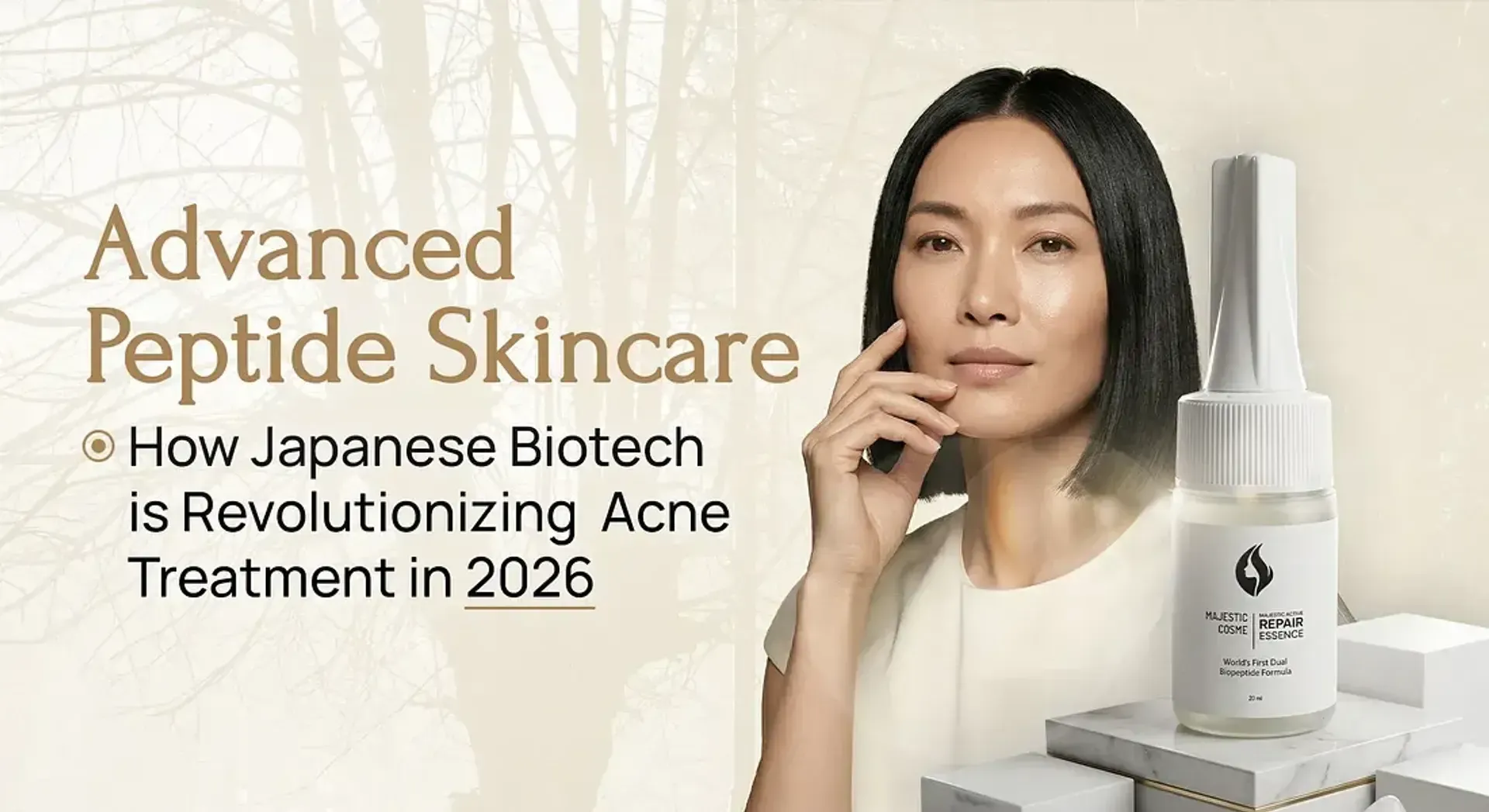
Advanced Peptide Skincare: Dual Biopeptide Engineering for Structural Acne Resolution
Advances in formulation science mean peptides are more stable, better absorbed, and used at clinically effective concentrations than ever before. In 2026, peptide skincare is no longer a supporting player in your routine. It is the main event. A growing body of clinical evidence shows that precision-engineered peptides can address acne, inflammation, and post-breakout repair more effectively than many of the harsh actives that have dominated skincare for the past two decades.
For women in their 30s, 40s, and 50s dealing with adult acne, the old solutions often create new problems. Benzoyl peroxide strips the skin barrier. Salicylic acid exacerbates dryness and sensitivity. Prescription retinoids cause purging that can last weeks. And none of these treatments address the underlying inflammatory and repair processes that determine whether acne scars, fades cleanly, or cycles back.
Japanese biotech has taken a different approach. Rather than attacking the skin to clear it, the focus is on restoring the conditions in which healthy skin can regulate itself. The result is a new generation of advanced peptide skincare products that are as precise as they are gentle, and backed by measurable clinical outcomes.
Introduction
Advances in formulation science mean peptides are more stable, better absorbed, and used at clinically effective concentrations than ever before. In 2026, peptide skincare is no longer a supporting player in your routine. It is the main event. A growing body of clinical evidence shows that precision-engineered peptides can address acne, inflammation, and post-breakout repair more effectively than many of the harsh actives that have dominated skincare for the past two decades.
For women in their 30s, 40s, and 50s dealing with adult acne, the old solutions often create new problems. Benzoyl peroxide strips the skin barrier. Salicylic acid exacerbates dryness and sensitivity. Prescription retinoids cause purging that can last weeks. And none of these treatments address the underlying inflammatory and repair processes that determine whether acne scars, fades cleanly, or cycles back.
Japanese biotech has taken a different approach. Rather than attacking the skin to clear it, the focus is on restoring the conditions in which healthy skin can regulate itself. The result is a new generation of advanced peptide skincare products that are as precise as they are gentle, and backed by measurable clinical outcomes.
The 2026 Peptide Skincare Revolution: Beyond Marketing Hype
Peptides have been marketed in skincare for over two decades, but until recently, most consumer products contained peptide concentrations too low to produce measurable biological effects. The peptides were present. They were not functional.
That has changed. Three developments have transformed the peptide skincare landscape entering 2026:
- Stabilization technology: Peptides are fragile molecules that degrade rapidly when exposed to air, light, and the wrong pH. New encapsulation and buffering systems allow peptides to remain active from the production line to the point of skin contact.
- Delivery innovation: Engineered carrier systems now transport peptides past the stratum corneum and into the viable epidermis and upper dermis, where they can interact with target cell receptors. Earlier formulas rarely achieved this penetration depth consistently.
- Concentration calibration: Research has established clinically effective thresholds for the most studied peptide sequences. Responsible formulators now work at or above these thresholds, rather than including token amounts for label appeal.
The combined effect of these advances is what makes Japanese regenerative skincare essence a fundamentally different category from the peptide products of five years ago.
The Future of Peptide Skincare: Precision Over Marketing Claims
The next frontier in peptide skincare is not about adding more peptides. It is about engineering the right peptides in the right combinations for specific biological targets.
| Criteria | Marketing-Led Formula | Science-Led Peptide Skincare |
|---|---|---|
| Peptide concentration | Below effective threshold; included for label positioning | At or above published clinically effective concentrations |
| Stability | Peptides may degrade before reaching the skin | Stabilized via encapsulation or pH-controlled delivery |
| Penetration | Surface-level contact only | Engineered to reach viable epidermis and upper dermis |
| Mechanism specificity | Broad "anti-aging" or "firming" claims with no defined pathway | Targets defined receptors: collagen synthesis, MMP inhibition, barrier repair |
| Clinical evidence | Consumer perception studies only | Instrumental measurements: profilometry, TEWL, cutometry |
Japanese Dual Biopeptide Complex: The Science Behind Superior Results
The Majestic Active Repair Essence is built around a dual biopeptide complex: a pairing of two functionally complementary signal peptides that address skin repair from two simultaneous directions.
The First Peptide: Activation
The first peptide in the complex functions as a collagen synthesis activator. It binds to receptors on dermal fibroblasts, the cells responsible for producing collagen, elastin, and hyaluronic acid, and upregulates their output. For acne-prone and post-acne skin, this is particularly relevant because breakouts accelerate collagen degradation in the surrounding tissue. Restoring synthesis rates supports the structural repair that determines whether skin heals with or without lasting marks.
The Second Peptide: Protection
The second peptide targets matrix metalloproteinases (MMPs), the enzymes that break down existing collagen and elastin. Acne lesions trigger an inflammatory cascade that significantly upregulates MMP activity in surrounding tissue. Left unchecked, this degradation accelerates the formation of post-inflammatory indentation and scarring. An MMP-inhibiting peptide applied during and after the active lesion phase reduces this collateral damage.
Why Two Peptides Together Outperform One
The logic is straightforward: you cannot effectively repair a structure if it continues to be broken down at the same rate. And you cannot stop breakdown without also rebuilding what was lost. The dual system addresses both sides of the equation simultaneously, producing a net positive outcome in dermal integrity that neither peptide could achieve working alone.
Why Traditional Acne Treatments Fall Short
Most conventional acne treatments were designed for adolescent skin: oilier, more resilient, faster-recovering. When the same treatments are applied to adult skin in the 30-55 range, where declining collagen production, slower cell turnover, and reduced barrier resilience mean the side effects frequently outweigh the benefits.
| Treatment | Mechanism | Common Side Effects in Adult Skin | Addresses Root Cause? |
|---|---|---|---|
| Benzoyl peroxide | Kills acne-causing bacteria; oxidizing agent | Dryness, barrier disruption, bleaching of fabric and hair | Partially: targets bacteria but not inflammation or repair |
| Salicylic acid | Chemical exfoliation; unclogs pores | Chronic dryness, sensitivity, barrier compromise with regular use | No: addresses pore congestion but not inflammatory or repair pathways |
| Retinoids (topical) | Accelerates cell turnover; regulates sebum | Extended purge period, photosensitivity, peeling, irritation | Partially: addresses cell turnover but often worsens short-term inflammation |
| Niacinamide | Reduces sebum, calms inflammation | Generally well tolerated; less effective for moderate-severe acne | Partially: anti-inflammatory but limited repair signaling |
| Dual biopeptide complex | Signals collagen synthesis; inhibits MMP degradation | Minimal; designed to work with rather than against the skin barrier | Yes: targets inflammation, repair, and structural protection simultaneously |
Advanced peptide skincare addresses the full cycle, from the acute lesion through to the tissue aftermath. The same repair mechanisms that reduce post-breakout scarring are also what make Clinical-Level Skin Treatment formulations relevant for anyone managing both acne and longer-term skin longevity.
Clinical Evidence: How Advanced Peptides Outperform Acids
The clinical literature on signal peptides has expanded significantly over the past five years. Key findings relevant to acne-prone and post-acne skin include:
Collagen Synthesis Upregulation
Studies on matrikine peptides have consistently demonstrated the ability to upregulate collagen type I and III production. A 2017 review documented measurable increases in collagen synthesis markers following topical application of peptide formulas at clinically effective concentrations.
MMP Inhibition and Scar Prevention
Research has shown that specific peptide sequences can reduce MMP-1 and MMP-3 activity in inflamed skin tissue. Reducing MMP activity during the post-lesion phase is directly correlated with improved healing outcomes and reduced likelihood of permanent textural scarring.
Barrier Repair Superiority Over Acids
A comparison of transepidermal water loss (TEWL) outcomes showed consistently lower TEWL values (better barrier integrity) in the peptide group. This is significant because a compromised barrier is a known risk factor for recurring breakouts.
Tolerance in Sensitive and Sensitized Skin
Clinical assessments across multiple studies have found peptide formulas to produce significantly fewer adverse events than retinoid or acid-equivalent concentrations producing similar collagen-related outcomes.
Building Your 2026 Peptide-Powered Routine
Incorporating advanced peptide skincare into an existing routine is straightforward, but sequencing and compatibility matter.
Morning Routine
- Gentle, low-surfactant cleanser.
- Hydrating toner or essence mist.
- Dual biopeptide essence. Pat gently into the skin rather than rubbing.
- Lightweight moisturizer with ceramides.
- Broad-spectrum SPF 30 or higher.
Evening Routine
- Oil-based cleanser followed by a gentle water-based cleanser.
- Dual biopeptide essence. The evening application takes advantage of the skin's natural repair cycle.
- Barrier repair moisturizer.
Majestic Active Repair Essence
Developed with a high-performance dual biopeptide complex in our Japanese laboratory. This essence is engineered for those who want real biological repair and visible skin health without the professional price tag.
Shop Majestic Active Repair Essence NowFrequently Asked Questions
Sources
- Schagen, S. K. (2017). "Topical Peptide Treatments with Effective Anti-Aging Results." Cosmetics, 4(2), 16. https://doi.org/10.3390/cosmetics4020016
- Gorouhi, F., & Maibach, H. I. (2009). "Role of topical peptides in preventing or treating aged skin." International Journal of Cosmetic Science, 31(5), 327-345. https://doi.org/10.1111/j.1468-2494.2009.00490.x
- Errante, F., et al. (2020). "Cosmeceutical Peptides in the Framework of Sustainable Wellness Economy." Frontiers in Chemistry, 8, 572923. https://doi.org/10.3389/fchem.2020.572923
- Wounds International. (2011). "International consensus: Acne vulgaris." Wounds International. https://www.woundsinternational.com
- Baumann, L. (2018). "How to use the Cosmeceutical Approach in Anti-Aging Medicine." Clinics in Dermatology, 36(2), 148-156. https://doi.org/10.1016/j.clindermatol.2017.10.008