.png%253Falt%253Dmedia%2526token%253D78c23398-5711-460d-b21c-4a7177094ae4%22%7D%2C%7B%22operation%22%3A%22resize%22%2C%22width%22%3A48%7D%2C%7B%22operation%22%3A%22output%22%2C%22format%22%3A%22webp%22%2C%22quality%22%3A75%7D%5D)
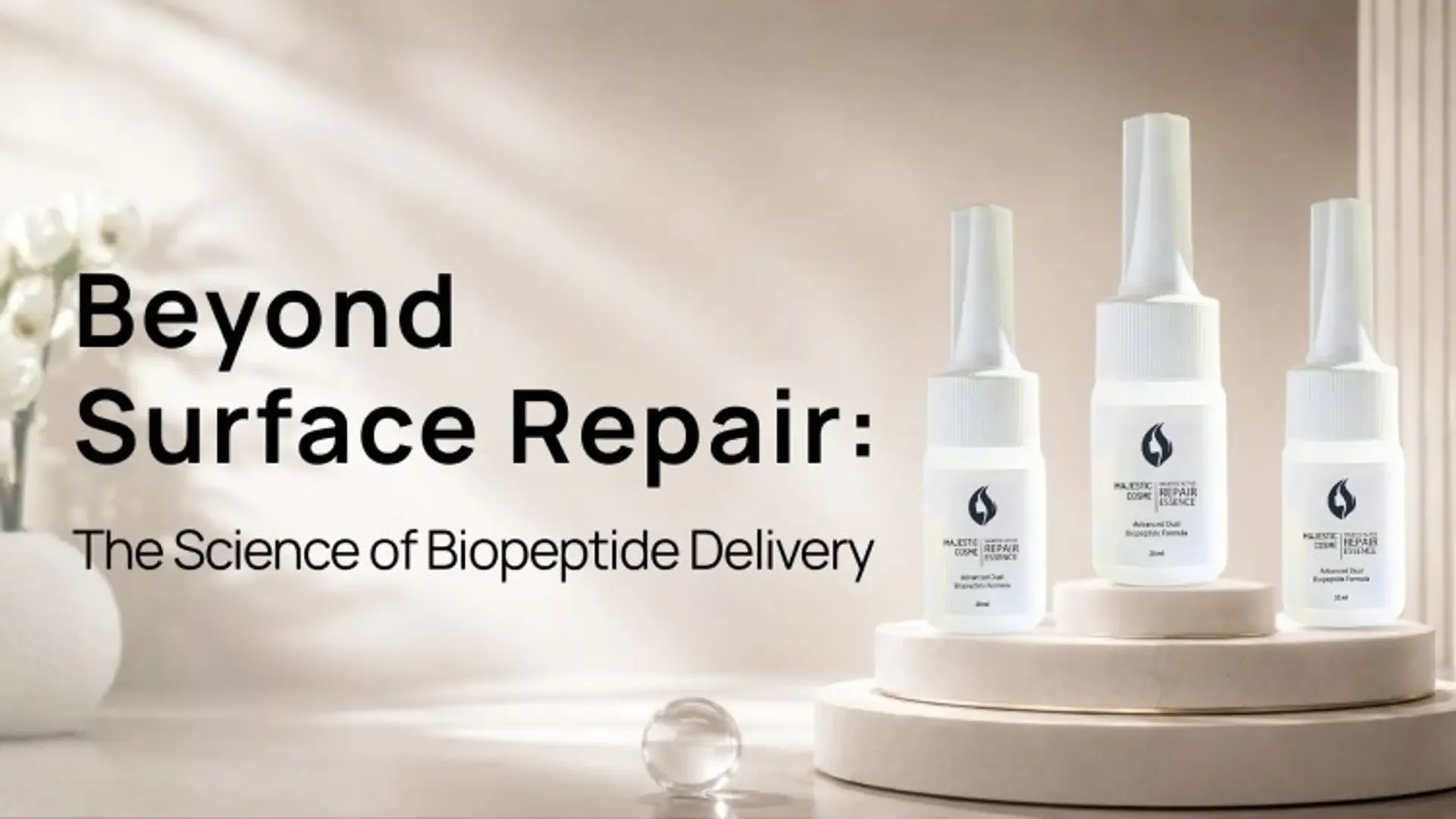
The Delivery Framework: Evaluating Macromolecular Liposome Transdermal Transit and Dual-Pathway Peptide Proteostasis
Most skincare products treat the skin surface. The most consequential biological activity in skin aging happens several layers deeper, in the dermis where collagen is built, elastin is maintained, and structural integrity is determined. Getting active ingredients to that depth, reliably and intact, is the central challenge of advanced formulation science.
Peptides are among the most precisely targeted actives available to skincare science. Their ability to bind to specific cell receptors and initiate defined biological responses makes them an ideal tool for addressing the cellular communication failures that drive visible aging. But this precision is only meaningful if the peptide survives the journey from the product surface to the receptor it is designed to find.
Majestic Active Repair Essence addresses this with a two part solution: synergistic dual biopeptides that target complementary repair pathways simultaneously, delivered through a liposome based system engineered to carry them past the stratum corneum and release them where their biological work begins. This article explains both dimensions of that technology and why together they produce outcomes that neither element could achieve independently.
Peptides are among the most precisely targeted actives available to skincare science. Their ability to bind to specific cell receptors and initiate defined biological responses makes them an ideal tool for addressing the cellular communication failures that drive visible aging. But this precision is only meaningful if the peptide survives the journey from the product surface to the receptor it is designed to find.
Majestic Active Repair Essence addresses this with a two part solution: synergistic dual biopeptides that target complementary repair pathways simultaneously, delivered through a liposome based system engineered to carry them past the stratum corneum and release them where their biological work begins. This article explains both dimensions of that technology and why together they produce outcomes that neither element could achieve independently.
The Power of Dual Biopeptides: More Than the Sum of Its Parts
A single pathway peptide is a precise tool for one task. A synergistic peptide pair is a coordinated system that addresses the interdependent biological variables that determine skin quality simultaneously. The dual biopeptide complex in Majestic Active Repair Essence is built around two signal peptides with complementary mechanisms of action.
- The first peptide is a matrikine class synthesis activator. It binds to receptors on dermal fibroblasts and upregulates the transcription of collagen type I and III genes, directly increasing the rate at which the skin most important structural proteins are produced. As collagen density improves, skin gains measurable firmness, volume, and mechanical resilience.
- The second peptide is an MMP inhibitor. Matrix metalloproteinases are the enzymes responsible for breaking down existing collagen and elastin. In aged and environmentally stressed skin, MMP activity is elevated significantly above the declining synthesis rate, creating a net degradation environment. This peptide inhibits MMP 1 and MMP 3 specifically, reducing the rate of structural protein breakdown and restoring a favorable net balance.
The synergistic principle at work here is straightforward but clinically significant. Increasing synthesis while degradation continues unchecked produces a modest improvement at best. Reducing degradation without also rebuilding what was lost addresses only half the deficit. The dual system creates a two directional advantage: building faster while breaking down more slowly. The net structural improvement exceeds what either peptide could produce working in isolation. For a detailed technical breakdown of how this synergy operates at the ingredient level, see our analysis of how dual peptide technology creates advanced skincare.
Intelligent Delivery Systems: Maximizing Peptide Efficacy
A peptide that cannot reach its target receptor cannot produce a biological result. This is the formulation problem that separates effective peptide products from those that carry impressive ingredient lists but deliver cosmetic rather than clinical outcomes. The stratum corneum, the outermost layer of the skin, is a highly effective barrier. Peptides face three specific challenges in crossing it:
- Size: Peptide molecules are larger than simple actives like niacinamide or retinol. Passive diffusion across the stratum corneum is limited for larger molecules without a delivery system to facilitate penetration.
- Charge: Many peptides carry an electrical charge that the lipid rich stratum corneum resists. Charged molecules do not cross lipid bilayers easily without encapsulation.
- Stability: Peptides are vulnerable to enzymatic degradation at the skin surface. Enzymes present in the outer skin layers can cleave peptide bonds before the molecule reaches its target, rendering the active ineffective.
An intelligent delivery system addresses all three challenges. Rather than relying on passive diffusion, it encapsulates the active in a carrier engineered to navigate the stratum corneum, protect the peptide during transit, and release it at the appropriate depth. The result is a formula where the concentration that reaches the dermal receptor layer meaningfully reflects the concentration in the product.
Liposome Technology: Your Skin VIP Pass for Deep Penetration
Liposomes are spherical vesicles composed of phospholipid bilayers, the same structural material that forms cell membranes. This compositional similarity is precisely what makes them an effective delivery vehicle: the lipid rich stratum corneum recognizes and permits the passage of lipid based structures in a way it resists aqueous solutions and free molecules.
- Barrier navigation: The phospholipid shell of the liposome fuses with or is absorbed by the lipid matrix of the stratum corneum, carrying its peptide payload through rather than over the barrier.
- Protection from degradation: The liposome enclosed environment shields the peptide from enzymatic activity at the skin surface, preserving its structural integrity until it reaches the deeper layers.
- Controlled release: Liposome formulations can be engineered to release their payload at a defined depth, ensuring that the biopeptide is deposited in the viable epidermis and upper dermis.
- Enhanced bioavailability: Studies on liposomal delivery consistently demonstrate significantly higher concentrations of active ingredient in deeper skin layers compared to equivalent free molecule formulations.
| Delivery Method | Penetration Depth | Peptide Stability | Receptor Interaction | Clinical Outcome |
|---|---|---|---|---|
| Free peptide in aqueous base | Limited to stratum corneum surface | Vulnerable to surface enzymatic degradation | Minimal; rarely reaches dermal receptors at effective concentration | Primarily cosmetic; surface moisture improvement |
| Peptide with penetration enhancers | Improved but variable and non-selective | Moderate; some protection depending on enhancer type | Improved but concentration at receptor layer unpredictable | Variable; dependent on formulation precision |
| Liposome encapsulated peptide | Targeted to viable epidermis and upper dermis | Protected within lipid shell until controlled release | High; peptide arrives at receptor depth intact | Structural and biological; measurable collagen and barrier outcomes |
Cellular Repair and Communication: The Core of True Rejuvenation
The biological outcomes of effective peptide delivery are not cosmetic in the superficial sense. They represent genuine changes in how skin cells behave, communicate, and perform their functions. When the synthesis activating biopeptide reaches fibroblast receptors at adequate concentration, the response is measurable: upregulation of collagen type I and III gene transcription, increased secretion of structural matrix proteins, and improved dermal density over weeks of consistent treatment.
When the MMP inhibiting biopeptide reaches its targets, existing structural proteins are preserved for longer, the net dermal density improves more rapidly, and the inflammatory collagen degradation that occurs around active lesions or UV stressed tissue is substantially reduced. The intercellular communication improvements extend beyond the fibroblast and MMP interactions. Keratinocytes respond by increasing barrier lipid synthesis efficiency. This is what distinguishes true rejuvenation from surface repair: the restoration of biological conditions, detailed qualitatively in our article on why mochi skin outperforms glass skin in 2026.
Why Synergistic Peptides Outperform Single Peptide Formulas
The performance gap between most standard products and a synergistic dual biopeptide system delivered via liposome technology comes down to compounding advantages. A synergistic dual system with liposome delivery that achieves high receptor level concentration produces potentially four to five times the net structural outcome because both synthesis and degradation are addressed with effective delivery simultaneously.
| Factor | Single Peptide Formula | Synergistic Dual Biopeptide with Liposome Delivery |
|---|---|---|
| Mechanism coverage | One biological pathway targeted | Two complementary pathways addressed simultaneously |
| Net structural outcome | Partial; synthesis improved OR degradation reduced | Complete; synthesis increases while degradation decreases concurrently |
| Peptide delivery depth | Often surface level without encapsulation | Targeted delivery to viable epidermis and dermis |
| Receptor concentration | Reduced by surface degradation | Preserved by liposomal protection; arrives at receptor intact |
Majestic Active Repair Essence: The Future of Advanced Skincare
The convergence of synergistic biopeptide science and intelligent delivery technology represents a genuine advance in what topical skincare can accomplish. Majestic Active Repair Essence embodies this convergence. Developed in Japanese biotech laboratories under JCIA regulated manufacturing standards, it applies cold process production to preserve peptide biological activity and liposome encapsulation to ensure that activity is delivered where it can produce measurable outcomes.
The results reflect this investment: measurable improvement in skin firmness at 8 to 12 weeks, faster recovery from UV exposure and environmental stress, and progressive improvement that compounds beyond the initial treatment period. The future of advanced skincare is formulation that earns its claims at the biological level.
Frequently Asked Questions
Majestic Active Repair Essence
Unlock the precision of Japanese liposome technology to deliver synergistic biopeptides where they matter most. Achieve structurally resilient skin with biological results that compound every day. Your skin is waiting for the signal.
Shop Majestic Active Repair Essence NowScientific References
- Schagen, S. K. (2017). "Topical Peptide Treatments with Effective Anti-Aging Results." Cosmetics, 4(2), 16. https://doi.org/10.3390/cosmetics4020016
- Gorouhi, F., & Maibach, H. I. (2009). "Role of topical peptides in preventing or treating aged skin." International Journal of Cosmetic Science, 31(5), 327-345. https://doi.org/10.1111/j.1468-2494.2009.00490.x
- Lasic, D. D. (1998). "Novel applications of liposomes." Trends in Biotechnology, 16(7), 307-321. https://doi.org/10.1016/S10167-7799(98)01220-7
- Errante, F., Ledwon, P., Latajka, R., Rovero, P., & Papini, A. M. (2020). "Cosmeceutical Peptides in the Framework of Sustainable Wellness Economy." Frontiers in Chemistry, 8, 572923. https://doi.org/10.3389/fchem.2020.572923
- Varani, J., Dame, M. K., Rittie, L., Fligiel, S. E., Kang, S., Fisher, G. J., & Voorhees, J. J. (2006). "Decreased collagen production in chronologically aged skin." American Journal of Pathology, 168(6), 1861-1868. https://doi.org/10.2353/ajpath.2006.051302
- Baumann, L. (2018). "How to use the Cosmeceutical Approach in Anti-Aging Medicine." Clinics in Dermatology, 36(2), 148-156. https://doi.org/10.1016/j.clindermatol.2017.10.008