.png%253Falt%253Dmedia%2526token%253D78c23398-5711-460d-b21c-4a7177094ae4%22%7D%2C%7B%22operation%22%3A%22resize%22%2C%22width%22%3A48%7D%2C%7B%22operation%22%3A%22output%22%2C%22format%22%3A%22webp%22%2C%22quality%22%3A75%7D%5D)
Learn How New Technology Can Block The Signals That Create Dark Spots and Repair Skin DNA.
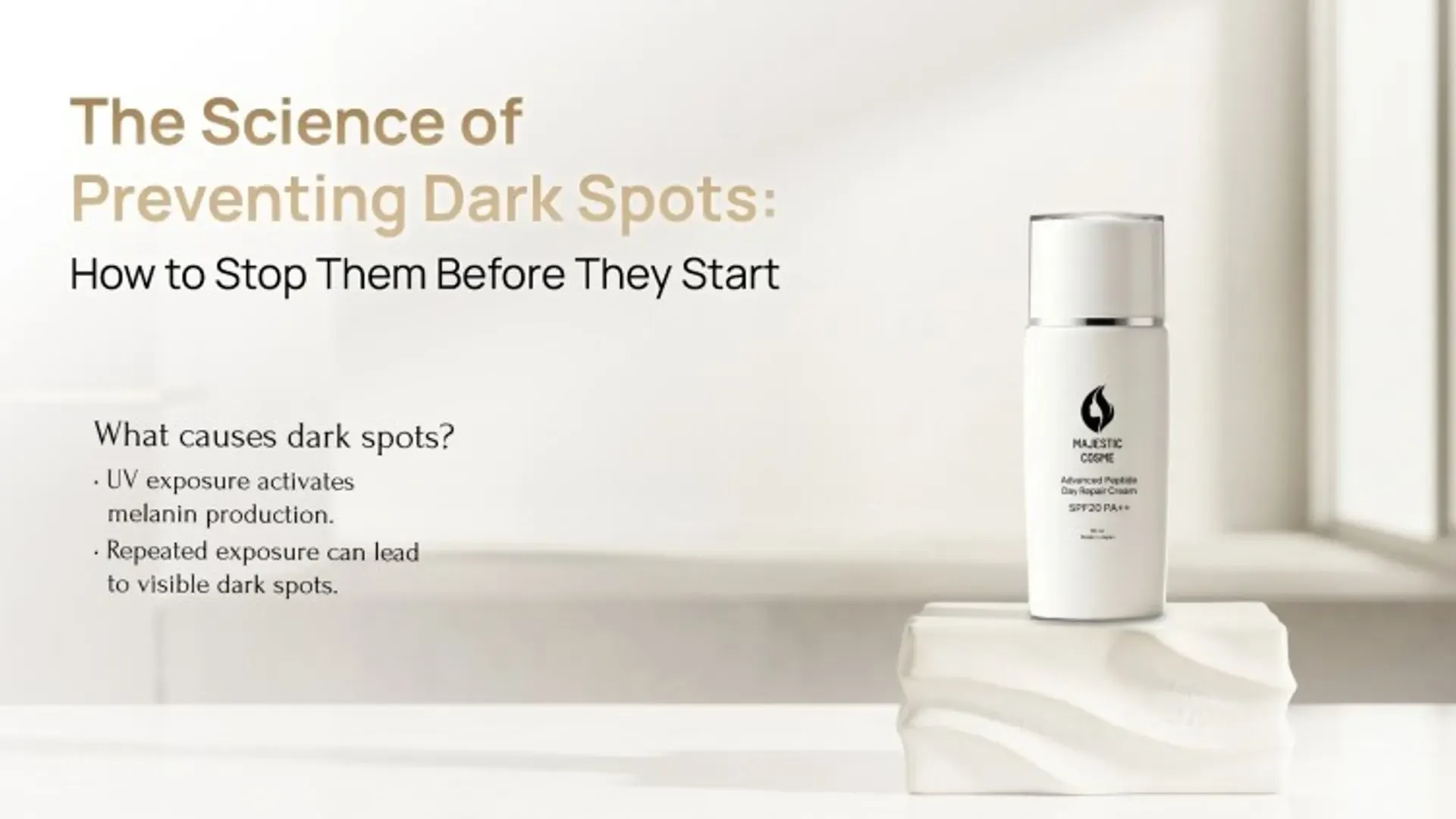
Direct insight: The most effective way to prevent dark spots is to use a daily UV protection cream that not only blocks sunlight but also intercepts the biological signals that trigger melanin production. Most dark spot treatments wait until discoloration appears before taking action. A more effective strategy addresses the problem at its origin, stopping the cellular command that creates pigmentation before it ever reaches your skin cells.
Majestic Day Repair is built around this preventative philosophy. Rather than functioning as a simple barrier against sunlight, the formula combines mineral UV protection with a functional peptide called ASP, designed specifically to block the hormonal signal responsible for dark spot formation. This guide explains exactly what causes dark spots, why most prevention strategies fall short, and how signal-blocking technology changes the equation.
What Really Causes Dark Spots on Your Skin?
Dark spots, also known as age spots or sun spots, develop when melanin becomes concentrated in specific areas of skin rather than distributed evenly. While many people assume these marks simply appear after enough sun exposure accumulates, the actual cause involves a precise biological sequence that begins the moment UV light contacts skin.
Melanin itself is not the enemy. This pigment serves as your skin's natural defense mechanism, absorbing UV radiation before it can damage cellular DNA. The problem arises when this defense response becomes uneven or excessive, creating visible patches of hyperpigmentation rather than uniform protective coloring.
Several factors influence where and how intensely dark spots form, including genetic predisposition, cumulative sun exposure over years, hormonal fluctuations, and skin injury or inflammation. However, the underlying trigger for nearly all of these factors traces back to the same cellular communication pathway, one that most skincare products never address.
Beyond Sunscreen: Blocking the Dark Spot Signal at the Source
Traditional approaches to dark spot prevention generally fall into two categories. The first relies on UV filters meant to physically or chemically reduce sunlight penetration. The second involves topical treatments like vitamin C, kojic acid, or hydroquinone, which interfere with the enzyme responsible for converting tyrosine into melanin after production has already begun.
Both strategies have value, but neither interrupts the alpha-MSH signal itself. UV filters reduce exposure but do not stop the hormonal cascade triggered by whatever light does get through. Enzyme-inhibiting treatments work further downstream, attempting to slow pigment formation after the cellular command has already been issued.
| Approach Type | What It Targets Biological Line | Prevention Threshold & Depth |
|---|---|---|
| UV Filters | Light penetration only | Surface barrier; light leaks can still activate deep hormonal triggers. |
| Tyrosinase Inhibitors | Melanin synthesis after signal | Reactive mitigation; attempts to block enzyme production post-command. |
| Signal Block (ASP) | Alpha-MSH command itself | True proactive cellular intercept; shuts down deep pigment signaling pathways. |
This is precisely the gap that advanced skincare formulations aim to close. By targeting the communication step between UV exposure and melanin production, it becomes possible to prevent dark spots from forming in the first place rather than managing them after the fact.
How ASP Technology Intercepts Melanin Commands
ASP, a functional peptide included in Majestic Day Repair, works through a mechanism distinct from conventional UV filters or brightening agents. Rather than blocking light or inhibiting enzymes, ASP is designed to intercept the alpha-MSH signal before it reaches melanocyte receptors.
When UV exposure triggers alpha-MSH release, this hormone normally travels through skin tissue searching for melanocyte binding sites. ASP peptides occupy or neutralize these signaling pathways, effectively preventing the hormone from successfully delivering its instruction. Without a completed command, melanocytes never receive the trigger to increase melanin output.
Proactive Prevention Priority Matrix
Because the intervention happens before pigment production begins, there is no melanin overproduction to correct later. The biological cascade that leads to uneven tone simply does not initiate, which is why this method is considered a true preventative rather than a corrective measure.
Importantly, this signal-blocking action does not interfere with skin's overall ability to tan or protect itself under normal conditions. It specifically targets the excessive, localized signaling that leads to visible dark spots and age spots, rather than suppressing melanin function broadly.
The Dual-Action Approach: Reflecting UV Rays and Repairing Skin DNA
While signal blocking addresses the hormonal trigger for pigmentation, comprehensive dark spot prevention also requires reducing the UV exposure that initiates this entire process and repairing whatever cellular damage does occur. Majestic Day Repair approaches both needs simultaneously.
The first layer of defense comes from a non-chemical formula using zinc oxide and titanium dioxide. These mineral particles sit on the skin's surface and physically reflect UV radiation away rather than absorbing it. This reduces the overall UV load reaching skin cells, lowering the volume of alpha-MSH that gets triggered in the first place.
Intercepts alpha-MSH commands before they reach melanocyte binding sites, blocking excessive pigment generation at the root.
Identifies UV micro-damage across cellular proteins and DNA, accelerating recovery before errors surface as photo-aging marks.
100% non-chemical mineral screen that sits on the skin surface to cleanly reflect multi-spectrum solar rays away.
The second layer addresses damage from any UV that does penetrate despite mineral protection. HSP, or Heat Shock Protein, functions as a cellular repair mechanism that identifies damaged DNA and structural proteins like collagen, then works to restore their proper function. This continuous repair process happens throughout the day, addressing micro-damage before it can compound into more visible signs of photo-aging.
Together, mineral reflection, signal blocking, and DNA repair create three complementary checkpoints against dark spot formation. Each mechanism addresses a different stage of the process, from initial UV contact through hormonal signaling to cellular recovery. This layered strategy is detailed further in our breakdown of HSP and ASP protein repair technology.
Is Daily UV Protection Safe for Sensitive Skin?
One common concern with daily UV protection involves compatibility with sensitive or reactive skin types. Many chemical sunscreens generate heat as they absorb radiation, a process that can aggravate conditions like rosacea or general sensitivity. This thermal effect is one of the most frequently reported sources of irritation among daily sunscreen users.
Because Majestic Day Repair relies on a non-chemical, mineral-based formula, it avoids this heat-generating mechanism entirely. Zinc oxide and titanium dioxide remain inert on the skin's surface, reflecting rather than absorbing radiation. This makes the formula generally well tolerated by sensitive skin types that may react poorly to chemical UV filters.
The formula is also designed to address environmental stressors beyond direct sunlight, including pollution and blue light exposure, which can independently trigger inflammatory responses linked to pigmentation. A closer look at this broader protective scope is available in our overview of multi-spectrum environmental defense.
As with any new skincare product, those with significant sensitivity or active dermatological conditions should patch test before full application and consult a dermatologist if concerns persist.
Frequently Asked Questions
Majestic Day Repair Shield
Secure your skin against dark spots using advanced ASP peptide signaling interceptors and pure non-heating mineral reflection. Intercept commands before they become permanent discoloration.
Secure Day Repair ProtectionSources
- Yamaguchi Y, Hearing VJ. Physiological factors that regulate skin pigmentation. Biofactors. 2009;35(2):193-199.
- Costin GE, Hearing VJ. Human skin pigmentation: melanocytes modulate skin color in response to stress. FASEB J. 2007;21(4):976-994.
- Videira IF, Moura DF, Magina S. Mechanisms regulating melanogenesis. An Bras Dermatol. 2013;88(1):76-83.
- Matsumura Y, Ananthaswamy HN. Toxic effects of ultraviolet radiation on the skin. Toxicol Appl Pharmacol. 2004;195(3):298-308.
- Brenner M, Hearing VJ. The protective role of melanin against UV damage in human skin. Photchem Photobiol. 2008;84(3):539-549.