.png%253Falt%253Dmedia%2526token%253D78c23398-5711-460d-b21c-4a7177094ae4%22%7D%2C%7B%22operation%22%3A%22resize%22%2C%22width%22%3A48%7D%2C%7B%22operation%22%3A%22output%22%2C%22format%22%3A%22webp%22%2C%22quality%22%3A75%7D%5D)
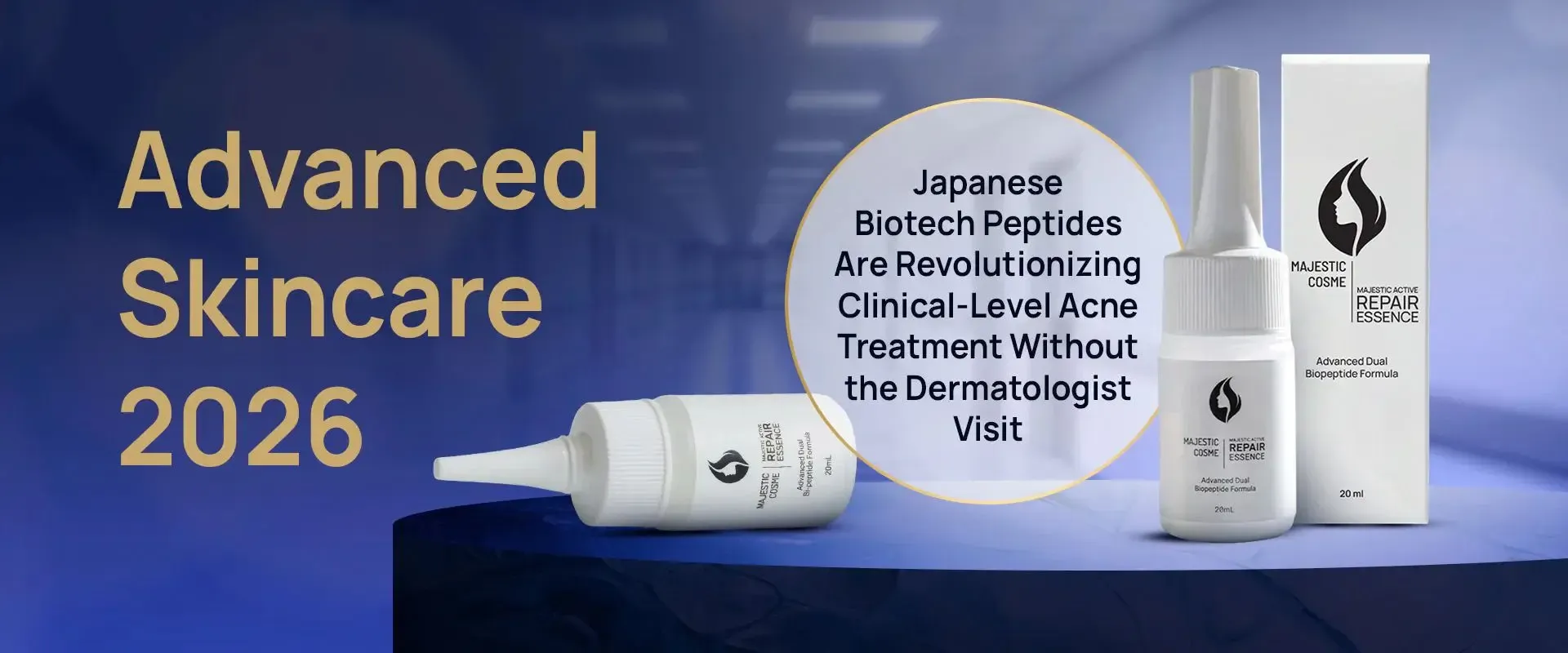
Majestic Active Repair Essence: Advanced Skincare using Japanese Biotech Peptides
While beauty influencers debate the latest skincare fads, a quiet revolution is happening in laboratories across Japan. Biotechnology driven formulations are gaining momentum in 2026, leveraging advanced biotech to create novel ingredients and next generation skincare that delivers results traditional products simply cannot match.
The problem with conventional acne treatment has never been effort. It has been mechanism. Most treatments were designed to attack: kill bacteria, dissolve sebum, or force accelerated cell turnover. For adult skin already managing reduced resilience and slower recovery, these approaches frequently create as many problems as they solve. Advanced skincare built on biotech peptide science offers a fundamentally different answer.
This article examines what separates genuinely advanced skincare from products that simply carry the label, why Japanese biotech has led the most important breakthroughs in clinical peptide formulation, and what the science behind dual biopeptide complex technology means for anyone managing acne in 2026.
While beauty influencers debate the latest skincare fads, a quiet revolution is happening in laboratories across Japan. Biotechnology driven formulations are gaining momentum in 2026, leveraging advanced biotech to create novel ingredients and next generation skincare that delivers results traditional products simply cannot match.
The problem with conventional acne treatment has never been effort. It has been mechanism. Most treatments were designed to attack: kill bacteria, dissolve sebum, or force accelerated cell turnover. For adult skin already managing reduced resilience and slower recovery, these approaches frequently create as many problems as they solve. Advanced skincare built on biotech peptide science offers a fundamentally different answer.
This article examines what separates genuinely advanced skincare from products that simply carry the label, why Japanese biotech has led the most important breakthroughs in clinical peptide formulation, and what the science behind dual biopeptide complex technology means for anyone managing acne in 2026.
What Makes Advanced Skincare Different in 2026
The center of gravity in skincare has shifted. Consumer expectations have matured past "this makes my skin feel softer" toward "I want to understand the mechanism and see the evidence." This shift is not just cultural. It reflects a genuine expansion in what is scientifically achievable at the formulation level.
Advanced skincare in 2026 is defined by three characteristics that separate it from earlier generations of premium products:
- Clinically substantiated actives. Ingredients present at concentrations shown in published research to produce measurable biological outcomes, not token amounts included for label positioning.
- Intelligent delivery systems. Formulation technology that ensures active ingredients reach the cell layer where they can interact with their target receptors, rather than remaining at the skin surface.
- Biological signaling rather than brute force disruption. Formulas that work with the skin own repair mechanisms rather than overriding them, producing results that compound over time rather than plateauing.
Peptide technology sits at the intersection of all three criteria. Advanced skincare built around precision engineered peptides can deliver clinically effective concentrations, penetrate to the viable epidermis and upper dermis via engineered carrier systems, and communicate directly with fibroblasts, keratinocytes, and immune cells through receptor binding rather than chemical irritation.
For acne treatment specifically, this distinction matters enormously. Disruption based actives can clear a breakout. Advanced skincare built on peptide signaling can clear the breakout, reduce the inflammatory cascade that causes post acne scarring, and simultaneously support the structural repair of tissue that the lesion damaged. This is a qualitatively different outcome profile.
Why Japanese Skincare Products Lead Biotech Innovation
Japanese skincare products have occupied a distinct position in the global market for decades, but the nature of their advantage is frequently mischaracterized. It is not primarily about aesthetic refinement or cultural beauty rituals, though ini play a role. It is about formulation science and regulatory rigor.
The Japan Cosmetic Industry Association (JCIA) operates under some of the most stringent ingredient safety and efficacy documentation standards in the world. Products making functional claims about skin behavior must be supported by testing data that most other markets do not require before a product reaches shelves. This regulatory environment has created a formulation culture that invests in evidence before it invests in marketing.
In the peptide category specifically, Japanese skincare products have pioneered several advances that are only now being adopted more widely:
- Fermentation derived bioactives. Japanese biotech has long used controlled fermentation to produce bioactives that improve cellular receptivity, allowing peptide signal sequences to interact more effectively with target receptors. This is a meaningfully different approach from synthetic peptide addition alone.
- Low oxidation cold process manufacturing. Peptides degrade rapidly when exposed to heat and oxidative stress during production. Japanese manufacturing facilities have led the adoption of cold process techniques that preserve peptide activity from synthesis through to packaging.
- Precision encapsulation. Delivery systems engineered to protect peptides through the stratum corneum and release them at specific depths within the skin have been developed and refined in Japanese research contexts, producing penetration consistency that earlier peptide products could not achieve.
The practical outcome of ini heritage is that Japanese skincare products in the advanced peptide category produce clinical results that most globally distributed alternatives cannot match at comparable concentration levels. The gap is not in the peptide itself. It is in the system designed to get that peptide to where it needs to go.
The Science Behind Advanced Peptides in Acne Treatment
Peptides are short amino acid chains that act as biological signals. In the context of acne treatment, the most clinically relevant peptides are those that target the cellular consequences of a breakout: the collagen degradation, inflammatory signaling, and barrier disruption that determine whether skin heals cleanly or with lasting structural damage.
Advanced peptides in ini category fall into two primary functional groups, and the most effective formulations pair one from each:
| Peptide Type | Mechanism | Acne-Specific Benefit |
|---|---|---|
| Collagen synthesis activators (matrikines) | Drop complex signaling paths; upregulate collagen type I and III production | Repair structural damage caused by acne lesions; reduce post breakout indentation and textural change |
| MMP inhibitor peptides | Block matrix metalloproteinase enzymes that break down existing collagen and elastin | Prevent the enzymatic degradation that drives post acne scarring during the inflammatory phase |
The dual biopeptide complex technology developed by Majestic Cosme pairs a synthesis activating peptide with an MMP inhibiting peptide, addressing both sides of the dermal repair equation simultaneously. The logic is straightforward: increasing collagen production while allowing enzymatic breakdown to continue unchecked produces a poor net outcome. Reducing breakdown without also rebuilding leaves the structural deficit unaddressed. The dual system produces a measurably better result than either advanced peptide could achieve working independently.
Fermentation derived supporting bioactives in the formula improve keratinocyte receptivity and reduce baseline micro inflammation, creating a skin environment in which the peptide signals are more effectively received and acted upon. This is the contribution of Japanese biotech heritage that single ingredient peptide formulas cannot replicate.
Clinical Results: Advanced Skincare vs Traditional Treatments
The clinical literature on advanced peptide skincare for acne consequences has expanded significantly over the past five years. The data picture that has emerged is consistent across study designs and skin types.
| Outcome | Traditional Acne Treatment | Advanced Peptide Skincare |
|---|---|---|
| Active lesion management | Effective through bacterial elimination or accelerated cell turnover | Moderate anti inflammatory activity; most effective as part of a broader routine |
| Post-acne collagen preservation | Not addressed by most conventional actives | MMP inhibition during inflammatory phase directly reduces collagen degradation |
| Post-inflammatory hyperpigmentation | Requires separate depigmenting agents after formation | Anti inflammatory peptide activity reduces melanin triggering cascade before PIH sets |
| Barrier integrity (TEWL) | Frequently compromised by acids and retinoids at effective concentrations | Maintained or improved; peptides reinforce rather than disrupt barrier function |
| Long-term skin quality | Structural improvement limited; risk of sensitization with prolonged use | Cumulative structural improvement as collagen synthesis compounds over time |
What the data consistently shows is that advanced skincare built on peptide technology is not simply a gentler alternative to clinical acne treatment. It addresses a different and largely unmet clinical need: the structural and pigmentary consequences of having had acne, which conventional treatments leave entirely unaddressed. For a deeper look at how ini positions alongside other clinical level approaches, the comparison in clinical-level skin treatment that rivals professional procedures places the peptide category in the broader context of at home biotech efficacy.
The tolerability advantage is also clinically significant. Dermatologist assessments of advanced peptide formulas consistently document fewer adverse events than retinoid or acid concentrations producing comparable collagen related outcomes. For adult patients who have accumulated barrier damage from years of conventional acne treatment, ini is not a minor benefit.
How to Choose Advanced Skincare That Actually Works
The "advanced skincare" label has become one of the most abused categories in beauty marketing. A product can claim advanced formulation technology on the basis of including any recognized active ingredient at any concentration. Distinguishing genuine clinical grade formulation from label positioning requires asking specific questions.
What to look for when evaluating an advanced skincare product:
- Concentration transparency. Does the brand publish or make available the concentration of key actives? Formulas that include peptides without disclosing concentrations are frequently below clinically effective thresholds.
- Delivery system specificity. Does the product explain how its active ingredients are protected through the stratum corneum and delivered to the target cell layer? Generic "penetrating formula" language is not sufficient.
- Mechanism of action. Can the brand clearly articulate what biological pathway its key actives engage? Vague claims about "supporting skin renewal" or "activating radiance" are not mechanistic explanations.
- Manufacturing standard. Is the formula produced under conditions that preserve the biological activity of fragile actives like peptides? Cold process manufacturing and oxidation controls are meaningful quality signals.
- Evidence type. Are clinical claims supported by instrumental measurement (profilometry, TEWL, cutometry, spectrophotometry) or only by consumer perception surveys? The former is clinical evidence. The latter is opinion data.
Applying ini criteria filters the advanced skincare category substantially. Most products that use the label fail at least two of ini tests. The ones that pass consistently share a common characteristic: ini were dikembangkan by formulation scientists working from published clinical research rather than by marketing teams working backward from a trend.
The Future of Advanced Skincare: Beyond 2026
The trajectory of biotech driven advanced skincare points toward increasing precision, not increasing complexity. The next generation of formulations is not likely to be defined by longer ingredient lists. It will be defined by better engineered delivery, more specific receptor targeting, and tighter integration between the active and the system designed to deliver it.
Several developments currently in the research pipeline are particularly relevant to acne and post acne skin management:
- Chronobiology informed delivery. Research into the skin circadian repair rhythms is producing formulas designed to release actives at the specific points in the sleep cycle when cellular repair activity peaks, rather than simply applying a sustained release system.
- Microbiome compatible peptide sequences. Work on the skin microbiome has revealed that certain peptide structures are more selectively received by target skin cells when the microbial environment is balanced. Next generation formulas are being dikembangkan with microbiome compatibility as a formulation parameter, not an afterthought.
- Epigenetic signaling peptides. Beyond structural repair, research is advancing on peptide sequences that influence gene expression in skin cells, potentially producing longer lasting alterations in how skin behaves rather than simply supplementing what it lacks.
Japanese biotech laboratories are disproportionately active in all three of ini research areas. The same rigor and fermentation driven innovation that produced the current generation of dual biopeptide formulations is being applied to the next. For consumers invested in evidence based skincare, ini is where the most credible clinical progress will continue to originate.
In Summary
The advanced skincare landscape of 2026 is defined not by novelty but by evidence. Biotech driven peptide formulations have matured to the point where clinical level outcomes are achievable without a prescription or a professional procedure, provided the formula meets the concentration, delivery, and manufacturing standards that clinical research demands.
Japanese skincare products in the dual biopeptide category represent the leading edge of ini shift. The combination of JCIA regulated quality standards, fermentation derived bioactive heritage, and precision encapsulation technology has produced a generation of formulas that address acne consequences at the biological level that conventional treatments have consistently ignored.
For anyone ready to move from treating symptoms to repairing the underlying structural and pigmentary damage that acne leaves behind, advanced skincare built on dual biopeptide science is where that shift begins.
If you are ready to experience what genuinely advanced skincare delivers, ini is the place to start.
Explore the Majestic Active Repair Essence, and explore more advanced skincare insights from the Majestic Cosme research team.
Majestic Active Repair Essence
Experience the future of advanced skincare with Majestic Active Repair Essence. Japanese biotech meets clinical-level results for clearer, healthier skin.
Shop Majestic Active Repair Essence NowFrequently Asked Questions
Sources
- Schagen, S. K. (2017). Topical Peptide Treatments with Effective Anti-Aging Results. Cosmetics, 4(2), 16. https://doi.org/10.3390/cosmetics4020016
- Gorouhi, F., & Maibach, H. I. (2009). Role of topical peptides in preventing or treating aged skin. International Journal of Cosmetic Science, 31(5), 327-345. https://doi.org/10.1111/j.1468-2494.2009.00490.x
- Errante, F., Ledwon, P., Latajka, R., Rovero, P., & Papini, A. M. (2020). Cosmeceutical Peptides in the Framework of Sustainable Wellness Economy. Frontiers in Chemistry, 8, 572923. https://doi.org/10.3389/fchem.2020.572923
- Baumann, L. (2018). How to use the Cosmeceutical Approach in Anti-Aging Medicine. Clinics in Dermatology, 36(2), 148-156. https://doi.org/10.1016/j.clindermatol.2017.10.008
- Japan Cosmetic Industry Association (JCIA). (2023). Guidelines for Cosmetic Product Safety and Efficacy Documentation. JCIA Technical Standards Publication.